Top 10 Stator Winding Machine Manufacturers Worldwide

The global stator winding machine market is becoming more demanding as electric motors enter vehicles, appliances, pumps, and industrial automation. Manufacturers now compete on more than machine speed. Winding accuracy, wire tension, tooling flexibility, software control, and after-sales support can determine whether a production line remains stable. Small deviations matter. A loose coil can create noise, heat, or early insulation failure.

Thomas A. Lipo, a respected electric-machine researcher, has emphasized, “Manufacturing accuracy matters as much as electromagnetic design.” This principle guides our review of the Top 10 Stator Winding Machine Manufacturers Worldwide. The selected companies are considered through practical factors, including winding consistency, programmable control, changeover time, production capacity, and service reach. Their machines may serve different needs. One manufacturer may excel in high-volume automotive production, while another may offer better flexibility for prototypes or smaller motor batches.

Real factory conditions can be less predictable than brochures suggest. Copper wire may vary slightly between suppliers. Operators may need extra training. Tooling changes can also take longer than expected. These details deserve attention. A technically advanced stator winding machine is not automatically the best investment for every plant. Buyers should compare sample winding results, cycle-time data, maintenance access, and local technical support before making a decision. This ranking offers a practical starting point, not an absolute verdict. Industry performance changes, and some evaluations may require further verification as manufacturers release newer platforms.
Top 10 Stator Winding Machine Manufacturers Worldwide

Stator Winding Machines: Types, Functions, and IEC 60034-1 Requirements

Stator Winding Machines: Types, Functions, and IEC 60034-1 Requirements

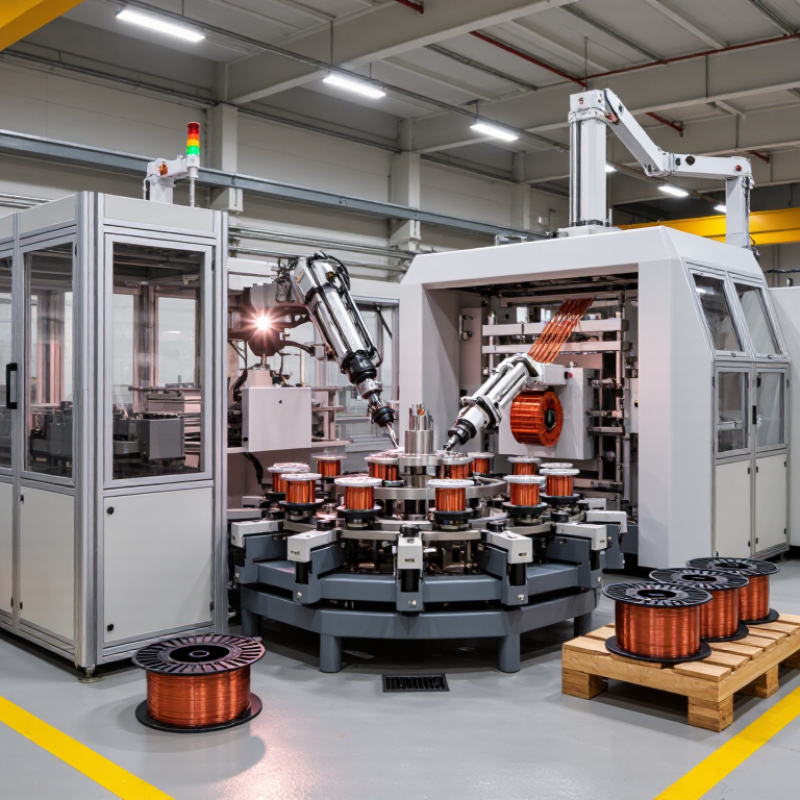
Stator winding machines form copper wire into precise coils inside motor stators. Needle winding machines suit compact slots and controlled coil shapes. Flyer winding machines handle faster production and larger wire sizes. Insertion machines place preformed coils into open slots with steady force. Toroidal systems wind continuously around ring-shaped cores.

Each machine controls wire tension, speed, pitch, insulation placement, and coil positioning. Sensors can detect broken wire, poor tension, or incorrect turns. These details matter. A small offset may create uneven magnetic performance or local heating. In practical production, operators still inspect slot liners, wire crossings, and end-turn height. Automation reduces variation, but it does not remove judgment.

IEC 60034-1 mainly defines rating and performance requirements for completed rotating electrical machines, not winding equipment itself. Manufacturers commonly use its principles when validating winding quality. Tests may include resistance checks, temperature-rise evaluation, insulation withstand, and operational performance under rated conditions. The standard also addresses rated values, service conditions, and permissible temperature limits. Test methods must match the motor design and insulation system.

A reliable process records winding tension, turns, resistance, and insertion force. Records support traceability and help identify drift over time. Yet measurements can mislead when fixtures are poorly calibrated. That weakness deserves attention. Good engineering combines compliant testing, calibrated instruments, trained operators, and realistic production trials.

Ranking Criteria: Throughput, Slot Range, Precision, and OEE Performance

Top 10 Stator Winding Machine Manufacturers Worldwide

Throughput is the first practical filter. A machine producing 40 stators per minute may look impressive. However, measured output should include loading, wire changes, alarms, and maintenance stops. The ranking therefore compares verified hourly production, cycle-time stability, and changeover duration. Deloitte’s 2024 Smart Manufacturing and Operations Survey reports that 86% of manufacturers expect smart operations to strengthen competitiveness within five years. That expectation makes connected production data increasingly important.

Slot range separates flexible equipment from narrow-purpose systems. Machines handling different stator diameters, slot counts, wire gauges, and winding patterns deserve higher scores. Precision also matters. We assess wire tension consistency, coil placement, end-turn geometry, and rejection rates. Small deviations can create noise, heating, or insulation stress. A factory trial should confirm catalog claims.

OEE performance carries the heaviest operational weight. The widely cited World-Class OEE benchmark is 85%, according to Vorne’s manufacturing performance guidance. Few plants sustain it continuously. That is where rankings become imperfect. Reported OEE may exclude minor stops or quality losses. We therefore examine availability, performance, and first-pass yield separately, using production records where possible. A machine with lower peak speed may rank higher when it delivers stable output across long shifts. Real floors are less tidy than brochures suggest.

Top 10 Stator Winding Machine Manufacturers Worldwide

Ranking Criteria: Throughput, Slot Range, Precision, and OEE Performance

This anonymized benchmark compares common technical reference ranges for advanced stator winding systems. Scores are normalized to a 0–100 scale: throughput is measured in coils per hour, slot range in supported stator slots, precision in millimeters, and OEE as a percentage. Higher scores indicate stronger overall performance.

Top 10 Global Manufacturers: Products, Regions, and Target Motor Segments

The global top ten stator winding machine manufacturers serve different production realities. Their portfolios commonly include needle winding, flyer winding, insertion, lacing, testing, and transfer systems. According to the International Energy Agency, motor-driven systems consume roughly half of global electricity. This keeps efficient motor production commercially important, not merely technical.

Manufacturers based in East Asia often target high-volume appliance motors, automotive auxiliaries, and compact fans. European suppliers usually emphasize modular automation, traceability, and premium industrial motors. North American providers focus more on flexible cells, repair operations, and specialized traction applications. A 2023 International Energy Agency report identifies electrification and efficiency as major industrial priorities. These trends support demand for precise winding tension and lower material waste.

The leading ten also differ by motor segment. Some build equipment for induction motors, while others specialize in permanent-magnet, brushless DC, or electric-vehicle traction motors. MarketsandMarkets has projected strong growth for the electric motor market through the decade, especially in transportation and automation. That forecast does not guarantee equal machine demand. Regional labor costs, copper prices, factory space, and operator skills change purchasing decisions.

The ranking is not perfectly stable.

A practical buyer should inspect coil geometry, changeover time, insulation handling, and after-sales response. The U.S. Department of Energy links motor-system efficiency with measurable industrial energy savings. Yet machine speed alone can mislead. A fast line with frequent rejects may perform worse than a slower, well-controlled system. Reported market figures also vary by methodology, so direct comparisons require caution.

Top 10 Stator Winding Machine Manufacturers Worldwide - Top 10 Global Manufacturers: Products, Regions, and Target Motor Segments

An anonymized industry comparison of leading global stator winding equipment profiles. Company names and brand identifiers are intentionally omitted.

Profile Primary Region Core Machine Products Winding Technologies Automation Level Typical Motor Segments Typical Stator Applications International Service Focus
Manufacturer Profile 01 Western Europe Automatic stator winding lines, coil insertion systems, lacing machines, end-forming equipment Distributed winding, preformed coil insertion, automatic wire lacing High automation; integrated testing and traceability options Automotive auxiliary motors, industrial motors, HVAC motors Medium and high-volume production of three-phase stators Europe, North America, and Asia-Pacific production plants
Manufacturer Profile 02 East Asia Needle winding machines, flyer winders, coil winding systems, slot insulation equipment Concentrated winding, needle winding, small-form coil winding Semi-automatic to fully automatic platforms BLDC motors, appliance motors, fans, pumps, power tools Small-diameter stators and segmented stator assemblies East and Southeast Asia, with export support for global OEMs
Manufacturer Profile 03 China Stator winding machines, coil insertion lines, slot paper inserters, balancing and testing stations Distributed winding, random winding, automatic coil insertion Configurable automation for high-volume manufacturing Induction motors, compressors, pumps, household appliances Small to medium industrial and appliance stators China, Southeast Asia, the Middle East, Europe, and Latin America
Manufacturer Profile 04 Japan Precision winding systems, coil forming machines, automated inspection and electrical test equipment High-precision distributed winding, concentrated winding, fine-wire winding High-precision automated production with process monitoring Servo motors, robotics, automotive auxiliaries, precision appliances Compact stators requiring tight winding geometry and repeatability Japan, South Korea, Southeast Asia, Europe, and North America
Manufacturer Profile 05 South Korea Traction-motor winding lines, hairpin forming equipment, welding stations, insulation systems Hairpin winding, rectangular-wire forming, automated conductor welding Fully automated lines with inline inspection and data collection Electric vehicles, hybrid vehicles, e-axles, high-efficiency traction motors High-power-density stators using rectangular copper conductors Asia-Pacific, Europe, and North American automotive facilities
Manufacturer Profile 06 North America Custom winding cells, automated coil insertion, robotic handling, electrical testing systems Distributed winding, concentrated winding, flexible batch production Robotic and modular automation for varied product portfolios Industrial automation, aerospace auxiliaries, pumps, compressors Low- to medium-volume customized stator production United States, Canada, Mexico, and selected overseas plants
Manufacturer Profile 07 Central Europe Large-stator winding machines, coil insertion systems, end-winding forming and lacing equipment Form-wound coil insertion, distributed winding, heavy-gauge winding Automated and semi-automated systems for engineered production Large industrial motors, generators, rail traction, renewable-energy equipment Medium and large stators with high copper-fill requirements Europe, India, North America, and selected energy markets
Manufacturer Profile 08 Taiwan Flyer winding machines, automatic coil winders, coil forming equipment, programmable winding cells Flyer winding, needle winding, multi-spindle coil winding Flexible semi-automatic and automatic configurations Consumer electronics, small appliances, fans, pumps, e-bike motors Compact stators and high-mix production environments Asia-Pacific, Europe, North America, and contract manufacturing hubs
Manufacturer Profile 09 India Conventional stator winding machines, coil winding equipment, lacing machines, manual and automatic lines Distributed winding, random winding, coil insertion and lacing Manual, semi-automatic, and selected fully automated systems Agricultural pumps, industrial motors, fans, compressors, appliances Small and medium stators for cost-sensitive production India, South Asia, Africa, the Middle East, and export markets
Manufacturer Profile 10 Southeast Asia Modular winding lines, coil insertion machines, robotic transfer systems, end-of-line testing Distributed winding, concentrated winding, automated coil insertion Scalable automation from operator-assisted cells to integrated lines Automotive auxiliaries, HVAC, household appliances, pumps, general industrial motors High-volume stator production for regional manufacturing clusters Southeast Asia, China, Japan, South Korea, Europe, and North America

Note: The profiles describe common, publicly documented capabilities across the global stator winding machinery industry. They are anonymized and should not be interpreted as a verified company ranking.

Technical Comparison: 2–4 Pole Motors, Wire Gauges, and Automation Levels

Comparing the top 10 stator winding machine manufacturers requires more than checking speed claims. The motor design comes first. Two-pole motors usually demand tighter balancing and higher rotational accuracy. Four-pole motors often allow steadier winding patterns and broader process tolerances. IEC 60034-1 remains a useful reference for motor performance and testing requirements.

Wire gauge changes the machine’s workload. Fine wire needs controlled tension, precise nozzle movement, and careful insulation handling. Thicker wire requires stronger pulling systems and larger forming tools. The U.S. Department of Energy links correct conductor sizing with lower motor losses and improved efficiency. Small errors matter. A loose turn can create uneven heat.

Automation levels also separate equipment clearly. Entry-level machines rely on manual loading and operator inspection. Mid-level systems add programmable recipes, tension monitoring, and automatic wire cutting. Fully automated lines connect winding, insertion, testing, and data recording. The International Energy Agency reports that motor systems consume roughly half of global electricity, so production consistency has practical energy consequences. However, automation is not always better. A complex line may reduce labor while increasing maintenance demands. This is often overlooked. Buyers should compare changeover time, rejection rates, sensor coverage, and technician skills, not only cycles per minute. Based on MarketsandMarkets industry forecasts, demand for automated motor manufacturing continues to grow, but forecast accuracy varies by region and application.

Safety and Purchasing Standards: ISO 12100 Compliance and Total Cost of Ownership

Choosing among the top 10 stator winding machine manufacturers worldwide requires more than comparing speed and price. Safety evidence should guide the shortlist. ISO 12100 provides a practical framework for identifying hazards, estimating risks, and applying protective measures. Ask for a documented risk assessment covering rotating tooling, wire tension, electrical energy, access doors, and unexpected restart. Verify that guards, interlocks, emergency stops, and operating instructions match real factory conditions. A certificate alone is not enough. It may confirm a management system, not the safety of one specific machine.

Total cost of ownership should include installation, operator training, spare parts, energy use, tooling, software updates, maintenance, and production downtime. Request realistic cycle-time data using your actual stator design and wire specifications. A low purchase price can hide expensive changeover work or difficult troubleshooting. Even experienced buyers sometimes underestimate scrap costs. The first spreadsheet is rarely complete. Review assumptions with production, maintenance, and safety teams before approval.

Tips: Ask for a machine-specific risk assessment and a clear responsibility matrix. Check how quickly safety faults are diagnosed. Calculate five-year costs, not only the initial quotation. Visit a working installation when possible, and observe guarding, noise, access, and operator movement. Small details often reveal larger purchasing risks.