2026 Top Stator Winding Machine Types for Global Buyers
The 2026 market for stator winding machine systems is becoming more specialized, automated, and application-driven. Electric vehicle production, industrial motors, compressors, and energy-efficient appliances all require precise copper placement. The International Energy Agency reported that global electric car sales exceeded 17 million units in 2024, representing more than one-fifth of new car sales. That expansion is increasing demand for repeatable motor manufacturing processes.
Automation is another important signal. The International Federation of Robotics recorded 541,302 new industrial robot installations worldwide in 2023. This figure shows how manufacturers are reducing manual handling and improving production consistency. In winding workshops, that trend appears through servo-controlled needles, programmable flyers, automatic wire tension systems, and integrated testing stations. Small details matter. A loose turn, damaged enamel, or poorly positioned coil can cause costly rejection.
This guide examines the leading stator winding machine types expected to attract global buyers in 2026. It compares needle winding, flyer winding, insertion winding, and flexible multi-station systems. Each design suits different stator geometries, wire sizes, production volumes, and quality requirements. The U.S. Department of Energy’s motor efficiency guidance also reinforces the importance of accurate winding and reduced electrical losses.
No single machine wins every application. Market reports sometimes use different definitions, making direct comparisons imperfect. Buyers should verify cycle time, changeover performance, tooling life, service coverage, and compliance documentation. A fast machine may still disappoint without reliable tension control. Practical testing remains essential.
What Is a Stator Winding Machine and How Does It Work?
A stator winding machine places insulated copper wire into the slots of a motor’s stationary core. In practical production, it replaces repetitive hand winding with controlled motion, tension, and counting. The machine usually includes a wire-feeding unit, winding head, slot tooling, servo drives, and a programmable controller. Different designs suit different products. Needle winders handle compact distributed windings, flyer winders support faster coil formation, and toroidal systems guide wire around ring-shaped cores. Selection depends on slot geometry, wire diameter, coil shape, and required output.
During operation, an operator loads the stator and enters winding data. The controller coordinates spindle rotation, nozzle or needle travel, and wire tension. The tool follows a defined path, placing each turn beside the previous turn without scraping enamel insulation. Sensors can detect wire breakage, abnormal tension, position errors, and incomplete turns. After winding, the machine may shape leads, bind coils, or transfer the stator to a lacing station. Actual results depend heavily on setup. A perfect program cannot correct a poorly aligned fixture.
From production experience, stable tension is often more important than headline speed. Excessive speed can create crossed turns, loose coils, or damaged insulation. Engineers should inspect samples under magnification, measure resistance, and test dielectric strength against applicable requirements. Maintenance also matters: clean guides, calibrated tensioners, and timely tooling replacement reduce variation. Some specifications look attractive on paper. They may fail with difficult wire or unusual stator designs. Trial winding with the buyer’s actual core remains the most reliable evaluation.
2026 Top Stator Winding Machine Types for Global Buyers
What Is a Stator Winding Machine and How Does It Work?
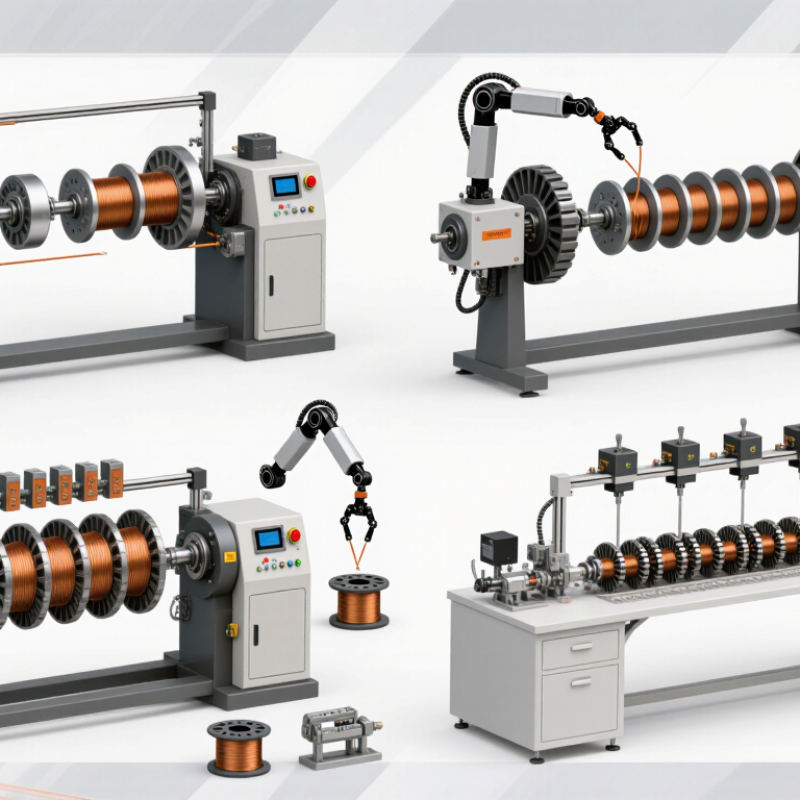
A stator winding machine places insulated copper wire into the stator slots to create the electromagnetic windings used in motors and generators. Flyer winding is commonly used for high-speed coil production, needle winding supports flexible insertion into concentrated or distributed slots, and winding-and-insertion systems combine coil forming with automated slot insertion. The speed ranges shown are generalized engineering planning ranges and vary with wire diameter, coil geometry, slot count, and automation level.
Main Stator Winding Machine Types Available in 2026
Global motor production is pushing manufacturers toward faster, more traceable winding systems. The International Energy Agency reported over 17 million electric cars sold worldwide in 2024. That growth increases demand for compact, efficient stator assembly lines. In 2026, buyers mainly consider flyer winding, needle winding, insertion winding, and toroidal winding machines.
Flyer winding machines suit distributed windings and medium-to-large stators. A rotating flyer places wire around the stator while tension controls insulation stress. Needle winding machines work well with compact, concentrated windings, especially where slots are narrow. They offer precise placement but may require slower tooling changes. Insertion winding machines place preformed coils into slots. They support repeatable production, though tooling costs can rise for multiple stator sizes. Toroidal machines handle ring-shaped cores and specialized motor designs. They are less universal.
Automation capability now matters almost as much as winding speed. The International Federation of Robotics recorded 541,302 industrial robot installations in 2023. This supports demand for machines with robotic loading, vision inspection, and digital process records. Buyers should compare wire diameter ranges, slot counts, tension accuracy, changeover time, and actual rejection rates. Published cycle speed can look impressive. It may not reflect production reality. In my view, machine selection remains imperfect because factory data often changes after installation. A practical trial still reveals more than a polished brochure.
| Machine Type | Typical Winding Method | Common Stator Applications | Typical Wire Range | Typical Stator Size Range | Typical Slot Range | Typical Production Capability | Main Advantages | Key Limitations | Best Buyer Profile |
|---|---|---|---|---|---|---|---|---|---|
| Needle Winding Machine | A winding needle guides round magnet wire directly into the stator slots or around individual teeth. | BLDC motors Small PMSM motors Appliance motors Fan motors | Approximately 0.10–1.20 mm round enamelled copper wire, depending on the machine configuration. | Approximately 20–180 mm stator outside diameter; application-specific fixtures may support larger sizes. | Typically 6–48 slots for concentrated or selected distributed windings. | Approximately 300–2,000 stators per hour, depending on slot fill, turns, wire size, and number of winding heads. | Flexible coil geometry, good control of tooth-coil placement, and suitability for compact stators. | Large wire sizes and very deep slots can reduce winding speed; tooling must match the tooth and slot geometry. | Manufacturers requiring flexible production for small and medium-sized permanent-magnet or electronically commutated motors. |
| Flyer Winding Machine | A rotating flyer places wire into the stator while the stator or winding head indexes between positions. | Induction motors PMSM motors Industrial motors Pump motors | Approximately 0.20–1.60 mm round enamelled copper wire; multiple wires may be wound in parallel. | Approximately 50–300 mm stator outside diameter, depending on the number of winding heads and tooling. | Commonly 12–72 slots for distributed or concentrated windings. | Approximately 100–800 stators per hour; parallel winding heads can increase throughput. | High winding speed, efficient continuous wire placement, and good suitability for repetitive production. | Less suitable for highly irregular coil shapes or extremely tight slot openings. | High-volume motor producers with stable product designs and repeatable winding programs. |
| Preformed Coil Insertion Machine | Prewound coils are transferred and inserted into the stator slots, usually with slot insulation and wedge handling. | Three-phase motors Industrial motors Compressors Automotive auxiliary motors | Approximately 0.30–2.50 mm round wire equivalent, depending on coil dimensions and insertion tooling. | Approximately 80–350 mm stator outside diameter. | Commonly 12–96 slots for distributed windings. | Approximately 60–300 stators per hour, depending on coil complexity, slot insulation, and insertion sequence. | High slot-fill potential, consistent coil placement, and compatibility with distributed windings. | Requires separate coil winding and forming operations; setup changes may require dedicated tooling. | Medium- and high-volume producers of AC induction, synchronous, and other distributed-winding motors. |
| Coil Winding and Insertion Line | Combines coil winding, coil forming, insulation preparation, coil insertion, wedging, and transfer operations in one automated line. | Industrial motors Traction auxiliaries Compressors Generator stators | Approximately 0.30–2.50 mm round wire equivalent, with parallel-wire options on suitable platforms. | Approximately 100–400 mm stator outside diameter, subject to line architecture and tooling. | Commonly 24–96 slots. | Approximately 40–180 completed stators per hour, depending on the number of stations and winding design. | Reduced manual handling, traceable process control, stable quality, and efficient material flow. | Higher capital cost, longer commissioning time, and lower economic efficiency for low-volume production. | Large manufacturers seeking repeatable mass production and integrated quality monitoring. |
| Hairpin Winding Machine | Forms rectangular copper conductors into hairpins, inserts them into slots, twists or positions the ends, and prepares them for welding. | Electric vehicle motors Hybrid vehicle motors High-power PMSM motors | Typically rectangular copper conductors with approximately 2–8 mm² cross-sectional area, subject to the motor design. | Approximately 120–350 mm stator outside diameter for common traction-motor applications. | Commonly 24–96 slots, often with multiple conductors per slot. | Approximately 20–120 stators per hour for a complete automated hairpin process, depending on welding and inspection stages. | High copper slot fill, strong thermal performance, repeatable conductor geometry, and suitability for high-power density. | Requires precise forming, insulation control, end preparation, and reliable welding; equipment and tooling are specialized. | Automotive and high-performance motor manufacturers producing medium- to high-volume traction motors. |
| Toroidal Stator Winding Machine | Feeds wire through the central opening of a ring-shaped core while the winding shuttle rotates around the toroidal stator. | Toroidal transformers Ring-core motors Special electrical machines Current-related assemblies | Approximately 0.10–2.00 mm round wire, depending on core opening, turns, and insulation requirements. | Approximately 20–250 mm outer diameter for common toroidal assemblies. | Not generally defined by conventional radial stator slots; the winding is arranged around a ring-shaped core. | Approximately 20–300 units per hour, depending on turns, wire size, and winding density. | Even circumferential winding, compact construction, and suitability for ring-shaped magnetic cores. | Not suitable for conventional slotted stators; core geometry and central opening strongly affect productivity. | Manufacturers producing toroidal or ring-core electrical products rather than conventional slotted motors. |
| Chain Winding Machine | Forms a continuous chain of coils or coil groups that are subsequently positioned and inserted into the stator slots. | AC induction motors Large distributed windings Industrial generators Specialty motors | Approximately 0.30–2.50 mm round wire equivalent, depending on the coil form and winding specification. | Approximately 100–500 mm stator outside diameter in industrial configurations. | Commonly 24–120 slots. | Approximately 30–180 stators per hour when combined with forming and insertion equipment. | Efficient production of repeated distributed coil groups and reduced handling between related coil operations. | Primarily suited to standardized winding patterns; product changeovers can require dedicated guides and tooling. | Industrial motor producers with long production runs and established distributed-winding designs. |
How to Compare Machine Design, Speed, and Winding Accuracy
2026 Top Stator Winding Machine Types for Global Buyers
How to Compare Machine Design, Speed, and Winding Accuracy
Machine design should match the stator, wire size, and production mix. Needle winders suit compact slots and flexible coil patterns. Flyer winders can support higher output, but they demand careful tension control. Insertion machines handle preformed coils efficiently, especially in repeat production. The U.S. Department of Energy’s Motor Systems Market Assessment reports that motor-driven equipment uses about 68% of industrial electricity. Small winding defects can therefore affect both quality and energy performance.
Speed figures need context. A supplier may quote revolutions per minute, but actual output depends on wire diameter, slot fill, changeover time, and rejected parts. I have seen fast equipment lose productivity through frequent stoppages. Measure completed good stators per hour instead. Run a factory acceptance test with the buyer’s wire, insulation, and core dimensions. That is more useful than a brochure number.
Accuracy requires measurable evidence. Check wire tension stability, coil placement, end-turn height, and insulation damage after winding. Use vision inspection and electrical tests, then record results across several batches. IEC 60034-2-1 provides recognized methods for motor performance testing, although it does not define every winding-machine tolerance. Buyers should request capability data, not only average results. A process reaching 99.8% accuracy once may still fail during a long shift. This assumption needs testing. Keep spare tooling, sensor records, and operator training in the comparison.
Which Stator Winding Machine Fits Each Motor Production Need?
2026 Top Stator Winding Machine Types for Global Buyers
Which Stator Winding Machine Fits Each Motor Production Need?
Choosing a stator winding machine starts with the motor’s geometry, not its price. Flyer winding machines suit compact stators, high output, and consistent coil shapes. Needle winding machines work well with tight slots and concentrated windings, especially in small brushless motors. For larger stators, winding systems with stronger tension control can manage thicker wire without damaging insulation.
High-volume factories often need automatic loading, wire cutting, indexing, and electrical testing. Flexible machines are better for mixed production, where operators change stator sizes during one shift. In pilot production, a machine may perform well at low speed but lose winding accuracy at full capacity. That detail deserves testing. A small setup error can create uneven turns, loose coils, or rejected assemblies.
Tips: Check slot depth, wire diameter, winding pattern, cycle time, and changeover requirements before purchasing. Request sample winding trials using your actual stator and wire. Measure tension stability, coil placement, insulation clearance, and operator access. Do not judge automation only by its advertised speed. Maintenance time matters. A simple machine with reliable adjustments may outperform a complex system in a smaller factory. Production plans also change, sometimes sooner than expected, so leave room for future motor models.
Key Buying Factors for Global Stator Winding Machine Buyers
2026 Top Stator Winding Machine Types for Global Buyers
Choosing a stator winding machine starts with the motor design, not the catalog headline.
Needle winders suit compact slots and flexible production. Flyer winders support higher output on many distributed windings. Chain winders can reduce handling for selected stator geometries. Toroidal machines remain useful for ring-shaped components. The correct type depends on slot count, wire diameter, winding pattern, and required changeover time.
The IEA’s Global EV Outlook 2024 projected more than 17 million electric car sales worldwide in 2024. This growth increases pressure on motor suppliers to improve repeatability and traceability.
Buyers should inspect tension control, wire break detection, programmable parameters, and automatic rejection systems. A fast cycle is not enough. Poor tension can create loose turns, insulation damage, and costly rework. In factory evaluations, sample winding tests are more reliable than brochure claims.
Automation also deserves careful measurement. The International Federation of Robotics reported 541,302 industrial robots were installed globally in 2023. This supports demand for integrated loading, testing, and data collection.
However, full automation may not suit every plant. Check fixture replacement time, operator training, spare-part availability, and local technical support. Energy use matters too, although many quotations present it poorly. Ask for measured consumption under production conditions, not idle-mode figures.
One overlooked issue is software access. A machine may be precise, yet difficult to adjust without the original engineer.
Related Posts
-
Why Choose an Automatic Stator Winding Machine?
-
Top 5 Best Stator Winding Machines for Efficient Manufacturing?
-

How to Choose the Best Motor Stator Winding Machine?
-
China Top 10 Automatic Motor Coil Winding Machine Suppliers
-
Why Choose a Motor Stator Winding Machine?
-
Top Benefits of Using an Automatic Stator Winding Machine?