Top Coil Winding Machine Manufacturers in China
Demand for compact motors, transformers, and vehicle electrification is raising expectations for precision winding equipment. The International Energy Agency’s Global EV Outlook 2024 reports nearly 14 million electric cars were sold worldwide in 2023, representing about 18% of new car sales. That growth does not measure coil winding machine demand directly. It does show why manufacturers need repeatable winding, careful wire handling, and reliable production capacity.
China is a significant manufacturing base for electrical and automotive components. The International Federation of Robotics reported 276,288 industrial robots installed in China during 2023 in its World Robotics 2024 report. This figure reflects wider factory automation, not winding-machine sales. Still, automation trends make practical questions more important: Can a machine hold wire tension across a long run? How quickly can operators change bobbin sizes? And how accessible are spare parts and technical support?
This guide introduces top coil winding machine manufacturers in China and the capabilities buyers should compare. It considers machine types, winding accuracy, control systems, production flexibility, and after-sales service. A polished product page is not enough. Ask for sample-winding results, inspect the user interface, and confirm which materials and wire diameters the machine can process. Specifications can look similar on paper; performance may differ on the factory floor. Comparisons also have limits, since configurations and service quality can vary by model and region. Use the manufacturer overview as a starting point, then verify critical claims directly with suppliers.
Coil Winding Machines: Types, Applications, and Winding Processes
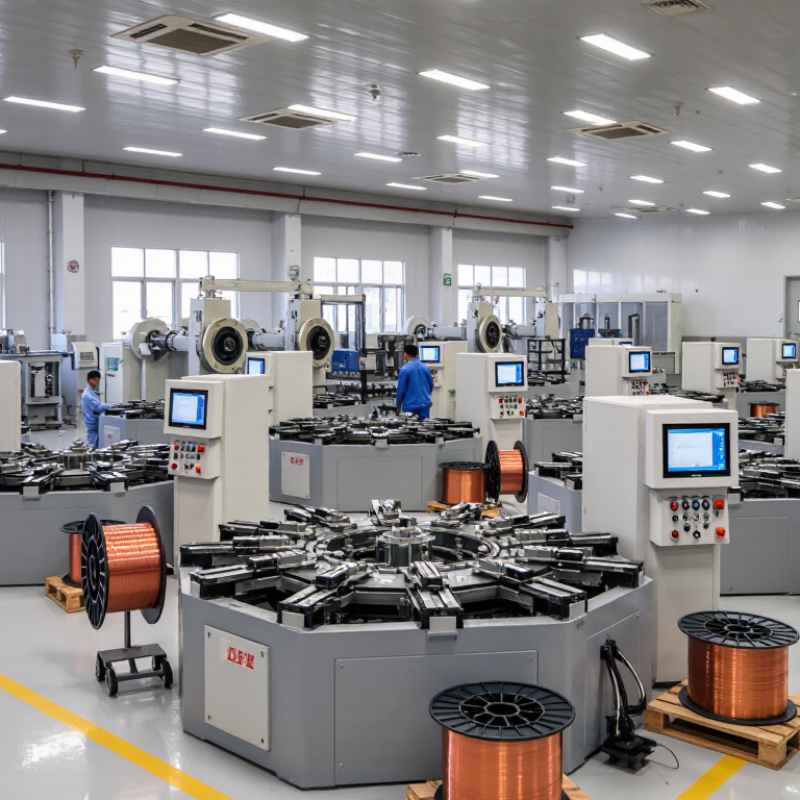
Coil winding machines form repeatable coils by controlling wire tension, speed, and placement. Common types include flyer winders for bobbins, needle winders for motor stators, and toroidal machines that guide wire through ring-shaped cores. Each suits a different geometry. A transformer coil needs orderly layers; a compact motor stator needs accurate placement in narrow slots. Applications also include inductors, solenoids, and generators. Small errors matter.
A typical process feeds insulated copper or aluminum wire from a spool, sets tension, winds a programmed pattern, and secures the leads. Operators then check dimensions, continuity, and insulation condition. Automation improves repeatability, but it cannot compensate for poor setup or damaged wire. A tidy-looking coil is not always a dependable one.
The International Energy Agency’s Global EV Outlook 2024 reports nearly 14 million electric-car sales in 2023, about 18% of global car sales. This growth strengthens demand for motor components and consistent winding capacity, though car sales alone do not measure winding-machine demand. For buyers comparing Chinese suppliers, useful checks include winding range, changeover time, tension control, and documented sample-coil results. Real production trials often reveal more than a specification sheet.
Key Performance Data: Wire Diameter (mm), Speed (rpm), Turns, and Tension
For buyers comparing coil winding machine manufacturers in China, headline figures need context. Wire diameter, speed, turn count, and tension work as a connected set, not isolated specifications. A machine rated for 0.1–1.2 mm wire may handle a narrow production range well, but the actual result depends on material, coil geometry, and tooling. Ask whether the stated diameter applies to copper wire, coated wire, or both.
Speed is usually listed in revolutions per minute. Yet a high rpm figure does not guarantee higher daily output. Acceleration, indexing time, and the number of winding heads all affect cycle time. Request a demonstration using a similar bobbin and winding pattern. Watch the wire guide during acceleration. Does it stay smooth? Small details matter. Published speed may describe an unloaded machine, so confirm operating speed under a realistic load.
Turn accuracy and tension control shape the finished coil. Check the allowed turn-count deviation across a full batch, not just one sample. Ask how tension is measured and adjusted, especially when wire diameter changes. Too much tension can stretch fine wire; too little can leave loose turns. Request sample coils and inspect spacing, layer edges, and resistance consistency. Specifications are useful, but they can still leave gaps; a written test record helps clarify them.
Leading Coil Winding Machine Manufacturers in China and Their Specialties
China’s leading coil winding machine manufacturers often build expertise around specific production needs. Some specialize in transformer winding, where controlled tension and accurate layer placement help create consistent coils. Others focus on motor stators, using multi-spindle systems to increase output across repeated winding cycles. Precision-focused suppliers may offer programmable machines for fine wire, compact bobbins, or complex winding paths. Their strengths vary, so a broad product catalog does not always mean deep experience in every application.
For buyers, useful differences appear in the details. Check whether the machine supports your wire diameter, coil dimensions, and required winding speed. Ask how operators set tension, change tooling, and manage recipe storage. A factory trial using your sample bobbin can reveal issues that a specification sheet misses. Good suppliers should explain setup limits and provide clear maintenance guidance. Still, automation is not magic; poorly matched tooling can cause uneven turns or slow changeovers. That deserves a second look.
Tips: Bring a sample coil drawing and wire specification to supplier discussions. Request a short test run, and inspect turn spacing, tension consistency, and changeover time.
Coil Winding Machine Reference: AWG Copper Wire Diameters
The chart shows nominal bare-copper conductor diameters for selected AWG sizes, a useful reference when specifying coil-winding applications. The enamel insulation increases the finished wire’s outer diameter.
Comparing Manufacturers by Axis Count, Winding Accuracy, and Production Capacity
When comparing coil winding machine manufacturers in China, axis count is a useful starting point, not a verdict. More axes are not automatically better. A four-axis system may suit repeatable bobbin work, while complex stators can benefit from coordinated motion and programmable wire guides. Ask manufacturers to wind the same part, wire gauge, and tension setting. Then inspect turn-count repeatability, wire placement, and insulation damage under magnification.
Accuracy figures need context. A quoted tolerance means little without the coil geometry, speed, and measurement method. Request sample coils and a written test protocol. A tidy brochure number can mislead. The International Federation of Robotics reported 541,302 industrial robot installations worldwide in 2023, with 276,288 in China (World Robotics 2024). That signals a highly automated manufacturing base, but it does not prove a winding machine’s precision. Verify performance on your own tooling.
Production capacity should mean acceptable coils per shift, not theoretical cycles per minute. Include loading, changeovers, operator checks, and rejected parts in the calculation. The IEA reported nearly 14 million electric-car sales in 2023, about 18% of global car sales (Global EV Outlook 2024), highlighting demand for motor-related manufacturing. Still, EV growth is not a direct forecast for any single winding line. Compare uptime records, service response, and spare-part lead times alongside rated output. Ask for a witnessed run using your actual coil design. That takes time. It may reveal a gap between advertised speed and stable production.
Quality and Safety Benchmarks: ISO 9001:2015 and IEC 60204-1:2016
For buyers comparing top coil winding machine manufacturers in China, ISO 9001:2015 is a useful quality benchmark, not proof that every machine performs equally. The ISO Survey 2022 recorded about 1.26 million valid ISO 9001 certificates worldwide. That figure covers many industries, so it cannot confirm a winding machine supplier’s specific capability. Ask for the current certificate scope, audit status, and sample inspection records. Look for traceable checks on wire tension, winding pitch, and finished-coil dimensions.
Details matter. IEC 60204-1:2016 addresses electrical equipment of machinery, including protection against electric shock, control circuits, and emergency stop functions. During a factory review, inspect cabinet labels, grounding connections, and clearly marked isolators. Ask how operators verify interlocks and respond to faults. A test record should identify the machine, test date, and result—not just show a passing tick.
A certificate alone is not enough. ISO 9001:2015 supports controlled processes and corrective action, while IEC 60204-1 provides a technical safety reference. Request documented evidence for both, then compare it with the machine on the production floor. One point can be easy to miss: a polished file may not reflect later design changes. Check that drawings, risk assessments, and test records match the delivered configuration.
Related Posts
-
China Top 10 Coil Winding Machine Manufacturers
-
China Top Coil Winding Machine Manufacturers Guide
-
What Is the Best Automatic Winding Machine from China?
-
China Top Coil Winding Machine Manufacturers
-
7 Tips for Choosing an Automatic Winding Machine
-
10 Essential Tips for Choosing the Best Auto Winding Machine?