
China Top Coil Winding Machine Manufacturers Guide
Choosing a reliable coil winding machine manufacturer requires more than comparing prices or browsing polished product pages. In real production environments, winding quality depends on tension control, spindle accuracy, wire compatibility, software stability, and operator support. A machine may look impressive in a showroom yet struggle with fine copper wire, irregular bobbins, or continuous shifts. This guide examines leading manufacturers in China through practical criteria, including engineering experience, machine construction, customization capability, quality inspection, and after-sales service.
Details matter.
Our review considers how suppliers handle sample winding, parameter testing, documentation, spare parts, and installation training. It also looks at their experience across transformers, motors, inductors, automotive components, and other electrical applications. Reliable manufacturers should explain measurable performance, not only make broad claims. Buyers should request winding samples, production references, technical drawings, and clear acceptance standards before placing an order. Factory visits or live video inspections can reveal assembly discipline, testing equipment, and the condition of finished machines.
No supplier is perfect.
Some manufacturers excel at standard models but offer limited customization. Others provide strong engineering support while requiring longer delivery times. These limitations deserve attention. Our comparison aims to help purchasing teams identify suitable partners based on application, production volume, budget, and long-term maintenance needs. It is not a universal ranking. Instead, it provides a practical starting point for evaluating China’s coil winding machine manufacturers with greater confidence, clearer questions, and more realistic expectations.
What Is a Coil Winding Machine and Why China Is a Major Supplier
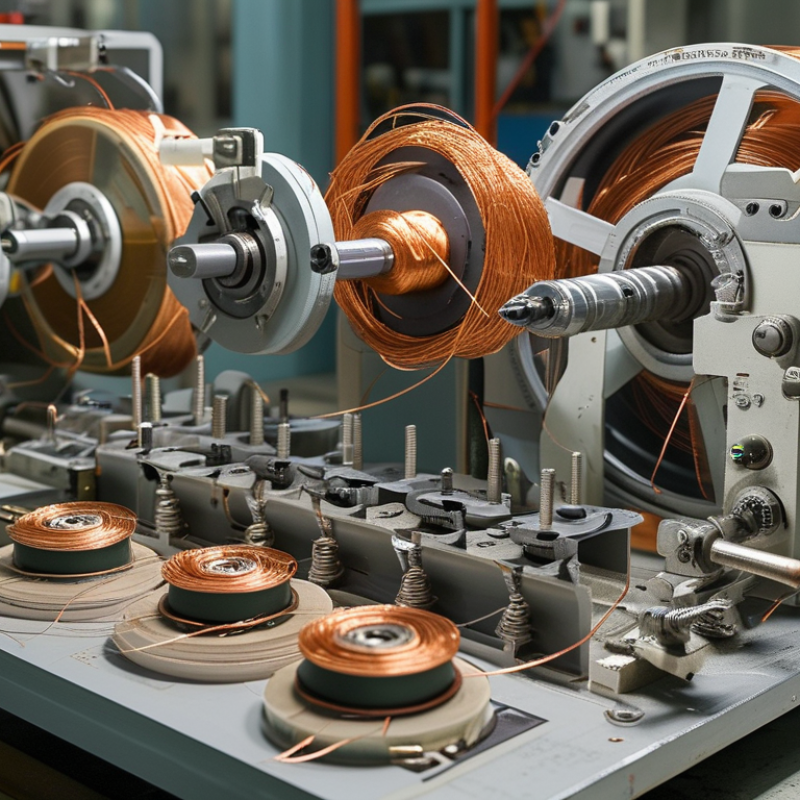
A coil winding machine forms insulated wire into precise coils for motors, transformers, sensors, and charging equipment. Its main systems include a spindle, wire guide, tension controller, traverse mechanism, and programmable control unit. The machine must manage wire tension carefully. Small errors can create loose turns, damaged insulation, or uneven magnetic performance. In production, operators also check winding width, coil resistance, and repeatability instead of trusting software alone.
China has become a major supplier because it combines broad electrical manufacturing capacity with dense component supply chains. The International Energy Agency reported that China produced more than 70% of global electric cars in 2023. This growth supports strong demand for motor coils, automation, and winding equipment. World Bank national accounts also show China contributing about 30% of global manufacturing value added. These conditions help manufacturers develop practical machines at different automation levels.
Price is only one factor. A useful supplier should provide test-winding records, tension data, electrical drawings, and clear spare-part standards. Factory acceptance trials matter. A lower quotation can hide slower setup or difficult maintenance. That weakness deserves attention. Buyers should compare cycle time, wire-size range, changeover steps, and after-sales response. Grand View Research identifies automation and electrification as important growth drivers for winding equipment, but market forecasts differ. Careful buyers should verify every figure and test the machine with their actual wire and bobbin.
China Top Coil Winding Machine Manufacturers Guide - What Is a Coil Winding Machine and Why China Is a Major Supplier
| Category | Dimension | Reference Information |
|---|---|---|
| Basic Definition | What is a coil winding machine? | An industrial machine that winds insulated wire, magnet wire, or other conductors into a controlled coil around a former, bobbin, stator, rotor, or other tooling component. |
| Core Function | Main manufacturing tasks | Wire feeding, tension control, winding, wire guiding, counting turns, positioning, cutting, and—on automated systems—transferring the finished coil to the next process. |
| Typical Products | Components produced | Transformer coils Motor windings Inductors Relays Solenoids Ignition coils |
| Machine Types | Common configurations | The main configurations include spindle winding machines, flyer winding machines, toroidal winding machines, needle winding machines, stator winding machines, transformer winding machines, and specialized coil insertion or winding systems. |
| Winding Method | Layer and pattern options | Depending on the product design, machines may perform layer winding, random winding, precision winding, orthocyclic winding, needle winding, or toroidal winding. The correct method depends on coil geometry, wire diameter, insulation requirements, and electrical performance. |
| Wire Compatibility | Materials and wire forms | Equipment may process copper or aluminum magnet wire, enamelled wire, litz wire, flat wire, round wire, and selected insulated conductors. Actual compatibility depends on wire diameter, insulation type, spool size, and machine tooling. |
| Production Scale | Suitable production environments | Manual or semi-automatic machines are commonly used for prototypes, laboratory work, and flexible small-batch production. Automatic and multi-spindle systems are suited to repeatable medium- and high-volume manufacturing. |
| Control System | Automation features | Modern systems can include programmable motion control, recipe storage, touch-screen operation, servo-driven axes, automatic turn counting, tension monitoring, alarm logging, and production data collection. |
| Performance Metric | Winding speed | Winding speed is normally specified in revolutions per minute or completed coils per minute. The practical speed is affected by wire diameter, coil dimensions, winding pattern, acceleration, tension limits, and required placement accuracy; the highest rated speed is not suitable for every product. |
| Performance Metric | Turn-count accuracy | Turn-count accuracy is critical for maintaining inductance, resistance, magnetic strength, and electrical consistency. It should be verified using a representative workpiece and the actual production recipe rather than relying only on a nominal machine specification. |
| Quality Control | Important inspection points | Key checks include wire breakage, enamel damage, coil dimensions, turn count, winding tension, lead length, insulation condition, resistance, inductance, hipot performance, and final visual appearance. |
| Precision Factors | What affects winding quality? | Important factors include stable wire tension, accurate traverse movement, suitable tooling, correct wire alignment, controlled acceleration and deceleration, consistent insulation handling, and a properly validated winding program. |
| Application Sector | Electrical and electronic products | Coil winding machines are used for transformers, inductors, chokes, relays, contactors, solenoids, sensors, filters, ignition components, and other electromagnetic assemblies. |
| Application Sector | Motors and generators | Specialized equipment is used for stator windings, rotor windings, armature windings, field coils, and other electromagnetic parts used in industrial motors, household appliances, power tools, pumps, and electric mobility systems. |
| Application Sector | Automotive and energy equipment | Typical applications include vehicle motors, charging equipment, ignition systems, sensors, transformers, inductors, power electronics, renewable-energy converters, and battery-related electrical assemblies. |
| Why China Is a Major Supplier | Industrial ecosystem | China has a broad manufacturing base for motors, transformers, power electronics, appliances, automotive components, automation equipment, precision machining, and electronic components. This ecosystem supports the development and customization of coil winding machinery. |
| Why China Is a Major Supplier | Customization capability | Chinese equipment manufacturers commonly offer customized fixtures, winding heads, wire guides, control programs, testing modules, and production-line integration for different coil sizes and manufacturing processes. |
| Why China Is a Major Supplier | Supply-chain access | A dense regional supply chain for motors, servo systems, sensors, control cabinets, mechanical parts, tooling, and electrical components can support shorter procurement cycles and easier replacement-part sourcing. |
| Why China Is a Major Supplier | Cost structure | Large-scale manufacturing, domestic component sourcing, and engineering labor availability can make Chinese machines cost-competitive. Total cost should still include tooling, installation, training, spare parts, validation, and after-sales service. |
| Supplier Evaluation | Technical capability | Review experience with the required wire type, coil geometry, winding pattern, turn count, tension range, automation level, and integration requirements. A sample-winding trial is a practical way to assess capability. |
| Supplier Evaluation | Factory acceptance testing | A useful acceptance test should use production-representative materials and tooling, measure agreed quality indicators, confirm cycle time, verify safety functions, and document repeatability before shipment. |
| Supplier Evaluation | Documentation and support | Before purchase, confirm the availability of operation manuals, electrical diagrams, pneumatic diagrams, spare-parts lists, maintenance instructions, software backups, training, remote support, and commissioning services. |
| Safety and Compliance | Required considerations | The machine should be assessed for guarding, emergency stops, electrical protection, safe access, moving-part hazards, wire-break conditions, pneumatic safety, and the compliance requirements applicable in the destination market. |
| Total Cost of Ownership | Costs beyond purchase price | Consider tooling, consumables, electricity, compressed air, operator training, maintenance, calibration, software support, spare parts, downtime, installation, logistics, and future product changeovers. |
| Best Selection Approach | Recommended purchasing steps | Define the coil specification, provide sample parts and wire data, request a technical proposal, conduct sample testing, compare validated output, review service capability, confirm acceptance criteria, and finalize delivery and warranty terms. |
Related Posts
-
Top 10 Stator Winding Machines for Efficient Motor Manufacturing?
-
10 Essential Tips for Using an Automatic Motor Winding Machine?
-
How to Choose the Best Micro Coil Winding Machine for Your Needs
-
2026 Best Heavy Duty Coil Winding Machine for Your Industrial Needs?
-
How to Choose the Best Motor Coil Winding Machine for Your Needs in 2025
-
How to Choose the Best Programmable Coil Winding Machine for Your Needs