China Top Motor Winder Machine Suppliers and Prices
China’s motor manufacturing sector is expanding alongside rising demand for electric vehicles and industrial automation. The International Energy Agency’s Global EV Outlook 2025 reports that electric car sales exceeded 17 million worldwide in 2024. China accounted for more than 11 million of those sales. This growth matters. More production can increase demand for consistent, high-throughput winding equipment, including the motor winder machine.
For buyers, supplier selection involves more than comparing a quoted price. Machine type, winding method, changeover time, and compatibility with a specific stator all affect the investment. A compact semi-automatic unit may suit a workshop producing several motor models. A high-speed automatic line may fit larger, repeatable orders, but it can require additional tooling and integration. Small details count: wire tension, nozzle access, and how quickly an operator can correct a miswound coil.
This guide examines Chinese suppliers, common machine configurations, and the factors that shape pricing. It also considers practical checks, such as requesting a sample winding, reviewing technical specifications, and confirming after-sales support. These steps help separate a low initial quotation from a machine that fits daily production. Still, supplier comparisons are not always tidy. Public listings may omit tooling, installation, or shipping costs, so prices should be treated as starting points—not final budgets. Reliable decisions depend on matching verified specifications to the motor design and production target.
What Is a Motor Winding Machine and How Is It Used?
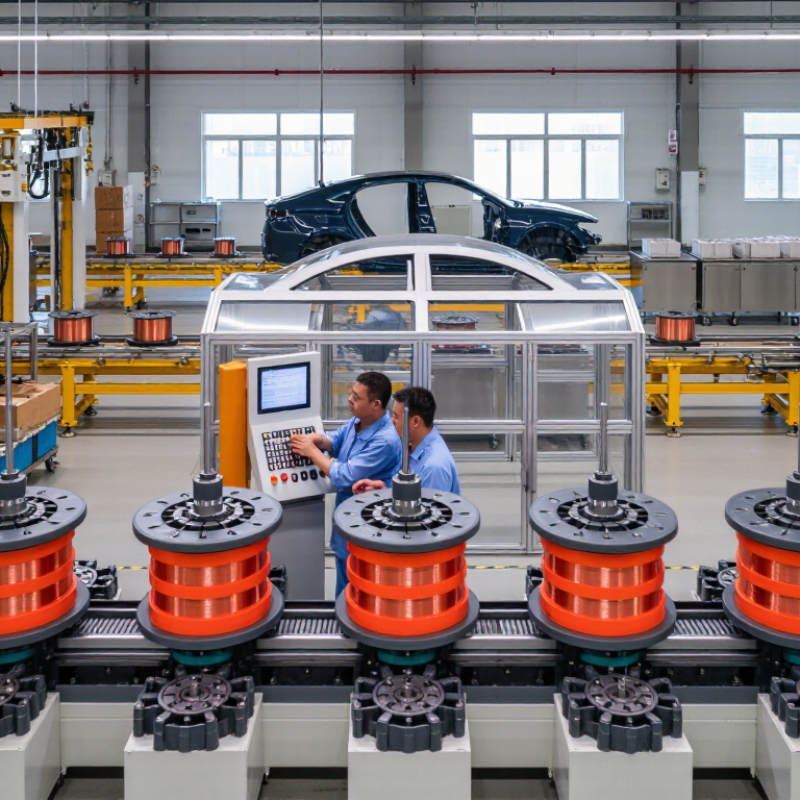
A motor winding machine places insulated copper wire into the slots of a motor’s stator or rotor. It follows a specified winding pattern, number of turns, and wire tension. The result is a coil designed to create a magnetic field when current flows through it. Small details matter. Poor tension or misplaced turns can damage insulation or affect the finished motor’s performance.
The machine is used in motor manufacturing and rewinding work. Depending on the design, an operator may load a stator, set winding parameters, and monitor the wire as coils are formed. Automated models can repeat winding patterns at production scale, while simpler equipment gives operators more manual control. The right setup depends on motor size, wire gauge, slot geometry, and required output—not just speed.
The International Energy Agency and UNIDO reported in 2011 that motor-driven systems account for about 45% of global electricity consumption. This figure describes the wider importance of motors, not the performance of winding machines themselves. After winding, technicians commonly inspect coil placement and insulation, then test electrical properties such as resistance. A neat-looking coil is not proof of a sound winding. I have seen setup checks treated as routine, when they are precisely where costly errors can begin.
Which Types of Motor Winding Machines Are Made in China?
China-made motor winding equipment ranges from compact bench machines to automated production lines. Flyer winding machines guide wire around bobbins or stator slots at controlled speeds. Needle winding machines place wire in narrow slots where access is restricted. Both can support concentrated or distributed winding patterns, depending on the motor design and tooling.
Stator winding equipment may include coil winding, coil insertion, shaping, and lacing machines. Some factories supply separate stations; others integrate wire feeding, tension control, and programmable motion. Rotor and armature winding machines accommodate different component geometries, while toroidal winding machines work with ring-shaped cores. Not interchangeable. A sample core, wire diameter, slot-fill target, and production rate help define suitable specifications.
For buyers comparing suppliers, “automatic” can mean different things. Ask whether loading, wire cutting, changeovers, and fault detection are included. Request a trial with your actual core and wire. A quick demonstration may look smooth, yet omit setup time. That matters for short production runs. Pricing depends on tooling, controls, production capacity, and support; a low quote may cover only the base machine. Easy to miss.
China Top Motor Winder Machine Suppliers and Prices - Which Types of Motor Winding Machines Are Made in China?
The price ranges below are indicative budget estimates in USD for machines commonly available from Chinese manufacturers. Actual quotations vary with winding-head configuration, automation level, tooling, motor design, and inspection or export requirements.
| Machine type | Typical application | Typical automation and features | Indicative price (USD) | Common purchasing considerations |
|---|---|---|---|---|
| Manual or benchtop coil winder | Prototypes, repair shops, and small-batch coils for motors or other electrical equipment | Operator-guided winding; basic speed control and a simple counter may be included | $300–$2,000 | Confirm wire range, winding dimensions, tension control, and whether tooling is included. |
| Semi-automatic stator coil winding machine | Small- and medium-volume production of coils for compatible stator designs | Programmable turns and speed; operator typically loads and unloads the tooling | $2,000–$10,000 | Check compatibility with slot geometry, coil pitch, wire size, and the required changeover tooling. |
| CNC multi-spindle coil winding machine | Repeat production of multiple coils, including coils used in motor stator manufacturing | CNC-controlled winding programs; multiple winding positions or spindles, depending on configuration | $8,000–$30,000 | Compare spindle count, usable winding envelope, wire tension system, controls, and output per shift. |
| Stator needle winding machine | Direct winding into stator slots, often for distributed or concentrated windings on suitable stators | A moving needle places wire into slots; configurations vary by stator size and winding layout | $10,000–$40,000 | Request a feasibility review using stator drawings, slot dimensions, wire specifications, and winding pattern. |
| Stator flyer winding machine | Stator winding processes where a rotating flyer guides wire around the winding area | Manual, semi-automatic, or automatic versions; tooling is matched to the stator and coil design | $5,000–$25,000 | Verify coil insertion space, flyer access, allowable wire tension, and whether change parts are included. |
| Rotor winding machine | Winding wire onto compatible wound-field motor rotors or rotor poles | May include indexed rotation, programmable turns, and dedicated rotor fixtures | $4,000–$25,000 | Specify rotor dimensions, winding method, wire size, turn count, and required fixture set. |
| Automatic stator winding and insertion line | Higher-volume stator production requiring winding and coil insertion operations | Integrated or linked stations; automation scope, handling, and testing options vary by line | $30,000–$150,000+ | Budget for engineering, tooling, installation, commissioning, guarding, and production acceptance testing. |
Prices are planning ranges, not verified offers or fixed market quotations. For comparable supplier quotes, provide a motor or stator drawing, winding specification, target output, required automation level, and destination country.
How Do Machine Specifications Affect Performance and Price?
For buyers comparing motor winder machines in China, specifications shape both production performance and the final quotation. A wider wire-diameter range offers flexibility, but may require different tension systems and tooling. Match the machine’s range to your actual motor designs, not occasional exceptions. Small mismatch, big headaches.
Spindle speed matters, yet maximum RPM alone says little about winding quality. Stable torque, controlled acceleration, and repeatable wire tension help prevent loose turns and damaged insulation. Servo-driven movement and precise traverse control can improve consistency, especially on compact stators. More automation can reduce manual handling, but adds controls, sensors, and maintenance needs. A specification sheet can still hide practical compromises.
Ask suppliers to state station count, supported stator dimensions, changeover time, and winding tolerances. These details affect throughput and price more clearly than a headline speed. A basic machine may suit one product family; multi-model production often needs programmable recipes and quick-adjust fixtures. Request a sample winding with your wire and stator, then inspect coil placement and tension. Compare included tooling, installation, training, warranty, and spare-part availability. The lowest quote may exclude essential setup. Leave room in the budget for trials and adjustments; real production is rarely as tidy as a brochure suggests.
China Motor Winding Machines: How Specifications Affect Performance and Price
How to read this chart: It shows theoretical spindle output power at constant torque levels. Values are calculated from the standard relationship P (kW) = torque (N·m) × speed (rpm) ÷ 9550, and are not measurements of any specific winding machine. Higher spindle speed can increase output power, while the torque a machine can sustain depends on its motor and drive system. These figures alone cannot determine a machine’s price: automation, winding-head configuration, supported wire sizes, controls, and supplier terms also affect quotations. Request a quotation based on your production requirements.
What Are the Main Types of Motor Winder Suppliers in China?
China’s motor winder suppliers generally fall into three groups. Dedicated winding-machine manufacturers build equipment such as coil insertion, winding, and lacing machines. Their strength is process-focused engineering: buyers can discuss wire diameter, slot dimensions, and changeover time directly with technical staff. Integrated automation suppliers combine winding stations with testing, handling, or production-line controls. They suit factories seeking fewer equipment interfaces, though customization can raise installation and service demands.
A third group consists of OEM/ODM producers and trading suppliers. OEM/ODM firms manufacture to a buyer’s specification, while trading suppliers may bundle equipment from several factories. The distinction is not always clear. Ask who designs the machine, who holds spare parts, and who provides commissioning support. A low quotation means little if the delivered machine cannot handle the stator core or production rhythm.
Demand context matters, but it does not identify the best supplier type. The IEA’s 2011 report, Energy-Efficiency Policy Opportunities for Electric Motor-Driven Systems, estimated that these systems use about 45% of global electricity. This broad figure signals the importance of motor efficiency, not the market share of Chinese winder suppliers. Compare suppliers using sample-winding results, cycle-time records, warranty terms, and a written scope of delivery. Details matter. A practical test is to request a trial using your own wire and core; some buyers overlook this until late in procurement.
How Can Buyers Compare Prices and Evaluate Suppliers?
When comparing motor winder machine prices, ask for quotations built around the same stator dimensions, wire range, winding stations, and automation level. A low headline price may exclude tooling, installation, operator training, or spare parts. Check the changeover time too; a machine that takes an hour to switch between coil types can disrupt a small production schedule. Small gaps matter.
The International Energy Agency’s 2011 report, Energy-Efficiency Policy Opportunities for Electric Motor-Driven Systems, estimates that motor-driven systems use about 45% of global electricity. This scale makes winding consistency and machine uptime practical concerns, not just sales claims. Request sample-winding results, measured cycle times, and references from plants producing similar motors. Ask for proof. The U.S. Department of Energy’s 2014 motor-systems sourcebook reports that motor systems account for about 68% of electricity use in U.S. manufacturing, but that figure is not a direct measure of winding-machine performance. Compare warranty coverage, service response, and consumable costs alongside purchase price. Some specifications look impressive on paper; I would still want them demonstrated on the buyer’s own stator and wire.
Related Posts
-
China Top 10 Motor Winder Machine Manufacturers?
-
Why Choose a Motor Stator Winding Machine?
-
10 Best Motor Winding Coil Machines for Efficient Production in 2023
-
2026 Best Motor Winder Machine for Global Buyers Tips?
-
What is an Auto Winding Machine? Exploring Efficiency and Precision in Coil Production
-
Auto Winding Machine Tips for Efficient Operation and Maintenance Guide