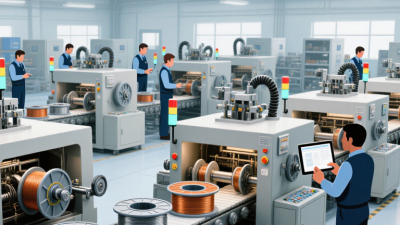
Why Choose a Wire Coiling Machine?
A wire coiling machine can turn a spool of wire into repeatable coils, springs, and formed parts with less manual handling. That matters when a production line needs consistent dimensions, steady output, and fewer adjustments between batches. Yet the right machine depends on wire diameter, material, coil geometry, and required volume. A fast machine is not automatically the best one.
Automation is reshaping manufacturing, though wire coiling has its own practical demands. The International Federation of Robotics reported 541,302 industrial robots installed worldwide in 2023, the second-highest annual total on record. For broader automation context, IFR President Marina Bill said, “The global demand for industrial robots remains high.” This is not a wire-coiling statistic, but it signals continued investment in automated production. Grand View Research has also reported growth in the wider industrial automation market, reflecting demand for efficient, repeatable processes.
Look closely at the workpiece. A small change in wire hardness can affect feed accuracy, while a worn guide may leave coils uneven. A suitable wire coiling machine can help control feeding, bending, and cut-off, but setup and maintenance still matter. That part is easy to underestimate. Buyers should compare forming range, tooling changes, control options, and after-sales support—not just quoted speed. Ask for a sample run using your actual wire and target shape. Measure the results. Keep the record.
This introduction draws on broad manufacturing evidence, not a dedicated wire-coiling market forecast. That distinction matters. The machine should solve a specific production problem, not merely look advanced on a showroom floor.
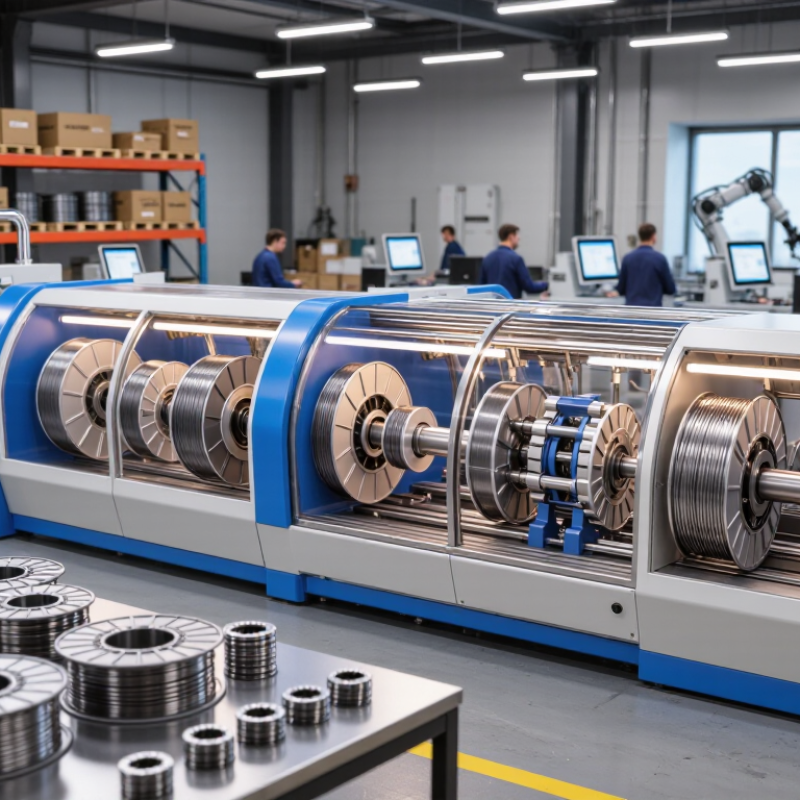
What a Wire Coiling Machine Controls: Tension, Pitch, and Coil Geometry
Choosing a wire coiling machine means choosing how precisely it controls tension, pitch, and coil geometry. Tension keeps wire feeding steadily through the guide and forming head. If it rises too high, the wire may stretch or show surface marks. If it drops too low, loops can shift or become uneven. Small changes matter.
Pitch—the spacing between adjacent turns—sets the coil’s length and fit. A stable feed rate and forming motion help maintain that spacing, especially when wire diameter or material changes.
Coil geometry depends on more than the forming tool. Mandrel size, wire springback, and feed alignment all affect the finished inner diameter and shape. A useful machine lets operators adjust these settings and repeat them across production runs. It should also make drift visible, rather than relying only on a quick visual check.
The 2024 Smart Manufacturing Survey reported that 86% of surveyed manufacturers viewed smart manufacturing solutions as a key future driver of competitiveness. That supports better process monitoring, but it does not prove automation can correct poor setup.
Real parts still need measurement. Check sample coils for pitch, diameter, and turn consistency, then record adjustments. That step can feel slow. It often prevents a longer run of rejects.
How IEC 60228 Conductor Classes 1, 2, 5, and 6 Guide Machine Selection
Why Choose a Wire Coiling Machine?
How IEC 60228 Conductor Classes 1, 2, 5, and 6 Guide Machine Selection
IEC 60228 classifies conductors by construction, not by the machine they require. Class 1 is solid; Class 2 is stranded; Classes 5 and 6 are flexible, with Class 6 using finer strands. That difference is visible at the feed rollers. A stiff Class 1 wire may need controlled bending, while fine-stranded Class 6 needs gentle tension and smooth guides to limit strand damage. Small details matter.
The standard also gives useful quality checks. For 1 mm² copper conductors, IEC 60228 lists maximum DC resistance at 20°C of 18.1 Ω/km for Class 2 and 19.5 Ω/km for Classes 5 and 6. These values do not set coil speed. They help confirm that the chosen wire meets its specification after processing. A machine trial remains essential; the same settings can behave differently across insulation types and spool conditions.
Market context matters, too. The International Energy Agency’s 2023 report, Electricity Grids and Secure Energy Transitions, says annual grid investment needs to exceed USD 600 billion by 2030. That points to growing pressure for reliable cable production, though it does not prescribe a coiling-machine design. Match the machine to the conductor class, coil diameter, and required handling speed. Then test real production wire. It can be messier than the spec sheet.
Which Production Metrics Matter: Wire Diameter, Coil Size, and Cycle Time
Why Choose a Wire Coiling Machine?
Which Production Metrics Matter: Wire Diameter, Coil Size, and Cycle Time
A wire coiling machine earns its place when its output meets the drawing and production target, not simply when it runs fast. Track three values: wire diameter range, finished coil dimensions, and cycle time per accepted coil. Grand View Research’s Wire and Cable Market report estimated the global market at $202.5 billion in 2022, with 4.4% annual growth forecast for 2023–2030. That suggests a growing production sector, but it does not prove every machine suits every product. Fit matters.
Wire diameter is the first gate. Test the smallest and thickest wire in your actual material range. A guide sized for nominal diameter can still mark soft insulation or let springback open the coil. Record inner diameter, outer diameter, pitch, and end position after cooling. A hot coil can look right and still miss the fixture. Cycle time should include loading, forming, cutting, and unloading, not just spindle rotation. The International Federation of Robotics’ World Robotics 2024 report recorded 541,302 industrial robot installations worldwide in 2023. Automation is widespread, but productivity gains are not automatic. Measure 30 consecutive coils at the intended setting and count rejects. Numbers can mislead. Changeovers and handling may erase time saved by faster winding. Recheck after a tool change; that detail is easy to miss.
How Programmable Winding Improves Repeatability Across Production Batches
A wire coiling machine can store key winding settings, such as turn count, feed speed, coil diameter, and wire tension. When the next production batch begins, the operator can reload the same program instead of rebuilding settings from memory. That matters. A small change in tension may alter coil shape, while an extra turn can affect fit during assembly.
Programmable winding helps keep these variables consistent, but it does not remove the need for careful setup. Operators should check the wire guide, confirm the material, and inspect a sample coil before running a full batch. Recording adjustments also makes it easier to trace differences between runs. A saved recipe is not a guarantee. Wire coating, spool drag, and tool wear can still change the result, so periodic checks remain useful. In practice, repeatability comes from combining stored parameters with hands-on inspection. Even a well-set machine can drift, and it is worth admitting that.
What to Check Before Purchase: Accuracy, Changeover Time, and Safety Features
Why Choose a Wire Coiling Machine?
What to Check Before Purchase: Accuracy, Changeover Time, and Safety Features
A coiling machine should produce consistent coils across a full production run, not just one good sample. Ask how accuracy is measured and what wire sizes the machine can handle. Then run your own material through it. Check coil diameter, pitch, and end position with simple measuring tools. Small differences matter. Wire tension, feed speed, and material spring-back can all affect the finished shape, so ask how operators adjust these settings.
Changeover time can quietly reduce output. Watch a change from one coil specification to another, using the tools and staff you expect to have on site. Note how long it takes to replace guides, enter settings, and produce an acceptable first coil. Saved programs can help, but they do not remove the need for a careful setup. I would not rely on a quick demonstration alone; real changeovers may be less tidy.
Safety deserves the same hands-on review. Look for guards around moving parts, accessible emergency stops, and clear instructions for setup and clearing jams. Ask how routine maintenance is performed and whether operators can reach adjustment points without entering hazardous areas. Test it live. A feature list is useful, but seeing the machine run—and asking operators what feels awkward—often reveals more. One detail may still be missed, so document open questions before placing an order.
Why Choose a Wire Coiling Machine? - What to Check Before Purchase: Accuracy, Changeover Time, and Safety Features
| Evaluation Area | What to Check | Practical Acceptance Criteria | How to Verify | Why It Matters |
|---|---|---|---|---|
| Coil dimensions | Repeatability of inside diameter, outside diameter, and coil width. | The buyer and supplier agree on tolerances for the specific wire, tooling, and end use before testing; there is no single tolerance suitable for every application. | Run the intended material and tooling, then measure a sample of coils with suitable calibrated instruments. | Consistent dimensions help coils fit downstream equipment and meet assembly requirements. |
| Cut length and end position | Length accuracy, cut quality, and consistency of the start and finish ends. | Acceptance limits are defined against the drawing or product specification, including any permitted burr or tail length. | Measure pieces from a production-like run and inspect cut ends under appropriate lighting or magnification. | Incorrect length or poor cut quality can cause assembly problems, rework, or scrap. |
| Repeatability over a run | Whether output stays within agreed limits after the machine reaches normal operating conditions. | A representative trial produces results within the agreed specification without frequent manual correction. | Request a documented run using the intended wire, speed, and coil program; review measured results and any adjustments made. | A successful single coil does not demonstrate stable production performance. |
| Changeover time | Time and steps required to switch between coil programs, wire sizes, or tooling. | Set a target based on the production schedule; define changeover from the last acceptable part of one job to the first acceptable part of the next. | Time a complete changeover during a demonstration, including tool changes, parameter entry, setup checks, and first-piece approval. | Shorter, predictable changeovers can reduce downtime when production includes frequent small batches. |
| Recipe and setup controls | Storage and recall of job parameters, access permissions, and protection against unintended changes. | Operators can select approved job settings and identify the active program; the required access-control method is agreed in advance. | Demonstrate saving, recalling, and editing a recipe, including how incorrect settings are detected or prevented. | Reliable setup control helps reduce errors between jobs and shifts. |
| Machine guarding | Guards and access protection around rotating, moving, cutting, and wire-feed components. | Risk controls are appropriate to the machine layout and intended operation; access to hazardous motion is controlled. | Inspect the machine during operation and setup, and review the documented risk assessment and guarding arrangements. | Wire, rotating tooling, and moving mechanisms can create entanglement, impact, or cut hazards. |
| Emergency stop and interlocks | Emergency-stop access, guard interlock behavior, reset procedure, and restart behavior. | Safety functions are documented, tested, and designed for the assessed risks; resetting a safety device does not itself initiate hazardous motion. | Request a functional safety demonstration and review the machine documentation and site-specific risk assessment. | Accessible, correctly functioning safety controls support safer intervention and recovery. |
| Standards and documentation | Risk assessment, electrical documentation, operating instructions, and applicable regional compliance requirements. | Documentation identifies the standards and requirements applicable to the machine and the installation location. ISO 12100 and IEC 60204-1 are relevant references for machinery risk assessment and electrical equipment, respectively. | Review the supplied documents with qualified safety and electrical personnel before purchase and installation. | Requirements vary by machine configuration and jurisdiction; documentation supports safe integration and operation. |
Note: Acceptance limits should be agreed for the intended wire material, product drawing, production rate, and installation environment. Use a production-representative trial to compare machine performance with those requirements.
Related Posts
-
Top 10 Wire Coiling Machine Manufacturers Worldwide
-
7 Best Automatic Wire Coiling Machines for Global Buyers
-
What Is the Best Automatic Wire Coiling Machine in China?
-
2026 Top Automatic Wire Coiling Machine Suppliers?
-
Top 10 Wire Coiling Machines for Global Buyers in 2026?
-
Auto Winding Machine Tips for Efficient Operation and Maintenance Guide