

How to Choose the Best Chocolate Bar Production Line?
Choosing the right Chocolate Bar Production Line is not simply a capacity decision. It is a long-term quality decision.
A line may promise 2,000 kilograms per hour, yet your real output can be lower. Chocolate viscosity, mould temperature, cooling time, and changeover skills all matter. A practical evaluation should begin with your product. Will you produce solid bars, filled bars, nut bars, or seasonal shapes? Each option requires different depositing, cooling, and demoulding capabilities.
Milton S. Hershey once said, “Give them quality. That’s the best kind of advertising.” His words still fit modern chocolate manufacturing. Consistent tempering creates the desired snap, gloss, and shelf stability. Precise filling control prevents leakage around the wrapper. A reliable cooling tunnel protects the bar from bloom and surface marks.
Look closely at the details.
Ask suppliers for factory trials using your actual chocolate recipe. Review energy consumption, cleaning access, spare-part availability, and operator training. A stainless-steel frame is useful, but easy maintenance may save more money over time. The cheapest line can become expensive when one small sensor stops production.
No line is perfect. That deserves honest attention.
Your production plan may change after six months. New flavours, smaller batches, or recyclable packaging can challenge a rigid system. Therefore, choose a Chocolate Bar Production Line with adjustable moulds, recipe control, and sensible upgrade options. Examine technical documentation carefully. Speak with existing users when possible. The best decision balances output, product quality, labour, hygiene, and future flexibility—not impressive machinery alone.
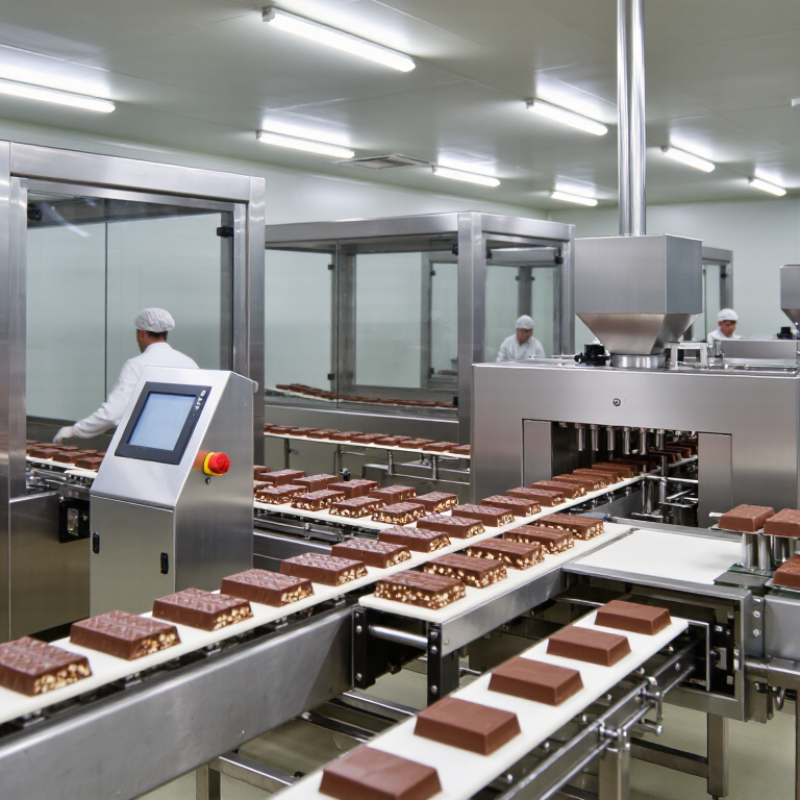
Define Product Type and Capacity: 100–2,000 kg/h Chocolate Output
How to Choose the Best Chocolate Bar Production Line?
Define Product Type and Capacity: 100–2,000 kg/h Chocolate Output
Begin with the product, not the machine. A molded milk chocolate bar needs tempering, depositing, cooling, and demolding. Filled bars require controlled centers, stronger cooling, and more cleaning time. Compound chocolate may need different temperature control because its fat system behaves differently. Small details matter.
Capacity must mean saleable chocolate output. A 100 kg/h line can produce 800 kg during an eight-hour shift, before stoppages and rejects. In practice, planned cleaning, changeovers, and material loss reduce this figure. A 70–85% effective utilization assumption is more realistic for early planning, although every factory differs. I have seen projects overestimate output by ignoring cooling-room limits.
For many growing operations, 100–300 kg/h supports market testing and regional distribution. Lines between 500 and 1,000 kg/h suit established products with regular orders. A 2,000 kg/h system needs dependable tempering, cooling, packaging, utilities, and raw-material storage. Otherwise, the larger line becomes expensive idle steel.
The International Cocoa Organization forecast 2023/24 world cocoa grindings at about 4.86 million tonnes, showing the scale of global processing demand. Yet global volume does not prove local sales. Use confirmed orders, shift patterns, bar weight, and seasonal demand before selecting capacity. A spreadsheet is useful. It can still be wrong. Recheck assumptions with production trials and measured cooling times.

Map the Process: Mixing, Refining, Conching, Tempering, and Molding
How to Choose the Best Chocolate Bar Production Line?
Choosing a chocolate bar production line starts with mapping each process, not comparing machine photos. Mixing combines cocoa mass, sugar, milk powder, and cocoa butter into a uniform paste. The mixer should provide steady shear without overheating delicate aromas. Small temperature changes matter.
Refining reduces particles to a smooth texture. Many producers target roughly 18–25 microns, but the ideal result depends on the recipe. Conching then develops flavor and removes unwanted moisture or acidity. It may require several hours. Check the conche’s temperature control, ventilation, scraper design, and cleaning access. A polished surface is not enough. Operators must verify texture, viscosity, and flavor through documented tests.
Tempering creates stable cocoa butter crystals, giving the bar a clean snap and glossy finish. The system should control heating, cooling, and agitation with reliable sensors. Molding follows. Depositors must fill cavities evenly, while vibration removes trapped air. A cooling tunnel should maintain consistent airflow and temperature. Otherwise, bars may show streaks, warped edges, or dull surfaces.
I once focused too heavily on output speed. That was a mistake. A faster line can create more waste when tempering drifts. Ask suppliers for trial data using your actual formula. Review changeover time, sanitation procedures, spare parts, and operator training. The best line is not always the largest one. It should match your recipe, floor space, labor skills, and quality checks. Nakne performance figures can mislead without production evidence.
| Process Stage | Main Purpose | Typical Operating Parameters | Key Equipment Features | Quality Indicators | Selection Considerations | Common Risks |
|---|---|---|---|---|---|---|
| 1. Ingredient Preparation | Prepare cocoa mass, cocoa butter, sugar, milk powder, emulsifiers, and flavor ingredients for consistent dosing and processing. | Ingredient temperature commonly maintained above the fat-melting point. Typical cocoa butter melting range: approximately 32–35°C. | Load cells, dust-controlled feeding, ingredient filters, heated tanks, and recipe-based dosing controls. | Accurate ingredient weighing, stable material temperature, low foreign-matter risk, and repeatable recipes. | Batch size Recipe flexibility Dust control | Dosing errors, ingredient clumping, moisture pickup, and contamination. |
| 2. Mixing | Distribute dry and liquid ingredients evenly and create a uniform chocolate paste before particle-size reduction. | Common mixing temperature: approximately 40–50°C, depending on formulation. Mixing time often ranges from 10–30 minutes. | Heated jacket, robust agitator, controlled scraper action, hygienic discharge, and variable-speed drive. | Uniform color, consistent fat distribution, no visible dry pockets, and stable feed to the refiner. | Agitator design Working volume Heating control | Uneven blending, excessive aeration, overheating, and incomplete discharge. |
| 3. Refining | Reduce sugar and cocoa particles to improve smoothness and prevent a gritty mouthfeel. | Finished particle size is commonly targeted around 18–25 micrometers for smooth chocolate products. Exact targets depend on recipe and sensory requirements. | Five-roll refiner or equivalent system, adjustable roll pressure, cooling control, and gap monitoring. | Particle-size distribution, smoothness, throughput stability, and absence of excessive metal wear particles. | Target particle size Throughput Roll cooling | Over-refining, coarse particles, roll overheating, and unstable feed consistency. |
| 4. Conching | Develop flavor, reduce undesirable volatile compounds, improve coating of particles with fat, and adjust rheology. | Typical conching temperatures: Milk chocolate: approximately 45–60°C. Dark chocolate: approximately 50–80°C. Time may range from 2–24 hours depending on recipe and equipment. | Heated vessel, high-shear or kneading action, controlled ventilation, variable-speed drive, and accurate temperature measurement. | Balanced aroma, reduced acidity, smooth texture, target viscosity, and consistent moisture level. | Flavor profile Energy use Batch or continuous | Flavor loss, excessive oxidation, moisture variation, and inconsistent viscosity. |
| 5. Holding and Filtration | Keep finished chocolate fluid and remove agglomerates or foreign particles before tempering and molding. | Holding temperature is commonly maintained approximately 2–5°C above the chocolate’s working temperature, according to formulation. | Insulated or heated tank, slow agitator, sanitary pump, inline filter, and level control. | Stable viscosity, uniform temperature, clean product flow, and minimal residence-time variation. | Tank capacity Filter rating Pump shear | Fat separation, blocked filters, temperature stratification, and prolonged residence time. |
| 6. Tempering | Form stable cocoa-butter crystals to produce a glossy surface, clean snap, and resistance to fat bloom. | Typical dark chocolate cycle: heat to about 45–50°C, cool to about 27–28°C, then rewarm to about 31–32°C. Milk and white chocolate generally use lower final working temperatures. | Multi-zone heat exchanger, automatic temperature control, continuous agitation, bypass loop, and temper index monitoring. | Gloss, snap, contraction from molds, stable viscosity, and correct crystal formation. | Chocolate type Flow rate Control accuracy | Fat bloom, dull appearance, poor demolding, thickening, and unstable temper. |
| 7. Molding and Depositing | Deposit a precise quantity of tempered chocolate into bar molds and create the required shape and weight. | Depositing temperature is normally close to the selected working temperature of the tempered chocolate. Weight tolerance should be defined by product specification. | Servo-controlled depositor, interchangeable molds, vibration table, automatic mold transport, and recipe storage. | Bar weight, fill level, surface definition, dimensional accuracy, and absence of air pockets. | Bar geometry Mold changeover Deposit accuracy | Underfilling, overfilling, trapped air, incomplete mold coverage, and product leakage. |
| 8. Cooling and Demolding | Solidify the chocolate evenly and release finished bars without distortion or surface defects. | Cooling tunnel conditions commonly use controlled air temperature and humidity. Product temperature must be reduced gradually enough to limit condensation and thermal stress. | Multi-zone cooling tunnel, insulated enclosure, adjustable airflow, humidity monitoring, and automated demolding. | Complete solidification, clean edges, stable dimensions, glossy surface, and easy release from molds. | Tunnel length Cooling capacity Humidity control | Condensation, cracking, warping, sticking, and uneven cooling. |
| 9. Inspection and Packaging | Verify finished-product compliance and protect bars from moisture, oxygen, light, odor transfer, and physical damage. | Inspection may include weight, appearance, seal integrity, metal detection, and code verification. Storage should be cool, dry, and protected from temperature fluctuations. | Checkweigher, metal detector, vision inspection, date coder, flow wrapper, and case packer. | Correct weight, intact packaging, readable coding, clean appearance, and conformity with specifications. | Pack format Line speed Traceability | Seal failure, incorrect coding, package contamination, and temperature-related bloom. |
Note: Operating temperatures, processing times, particle-size targets, and cooling conditions are typical technical ranges. Final settings should be validated for the specific chocolate recipe, cocoa-butter content, inclusions, bar size, equipment design, and local food-safety requirements.
Set Refining Targets: 15–30 μm Particle Size for Smooth Texture
How to Choose the Best Chocolate Bar Production Line?
Choosing a chocolate bar production line starts with the refining target. The central goal is a smooth texture without losing process control. Aim for particle sizes between 15 and 30 μm. This range usually reduces grittiness on the tongue. Particles above 30 μm may feel sandy. Extremely fine particles can increase viscosity and refining costs. Measure it carefully.
A reliable line should provide adjustable refining pressure, stable temperature control, and consistent material flow. During trials, operators should take samples from the same production stage. Use laser diffraction or another validated particle-size method. Check several samples, not only one. Record refining time, temperature, fat content, and moisture levels. These details reveal why results change between batches. A glossy surface alone does not prove smoothness.
Equipment selection should match the recipe and planned output. A powerful refiner may still perform poorly with unstable feeding. Conching also affects flavor, viscosity, and final mouthfeel. In practice, test the complete line with the intended ingredients. Do not trust a single impressive trial. A 20 μm reading is not a guarantee of perfect texture. Uneven particle distribution may remain hidden in the average result. The target is useful, but not sacred. Review sensory feedback beside laboratory data. Slight process adjustments may outperform a rigid specification.
Select Tempering Controls: 45–50°C Melting and 27–32°C Cooling
How to Choose the Best Chocolate Bar Production Line?
Tempering control deserves more attention than conveyor speed. Chocolate should melt at 45–50°C, removing unstable cocoa butter crystals. It should then cool gradually within the 27–32°C range. However, this range is not one universal setting. Dark chocolate often needs a higher working temperature, while milk and white chocolate require lower targets. Always confirm the recipe with a tempering curve test.
A reliable line should control temperature continuously, not only at the tank outlet. Look for separate heating, cooling, and reheating zones. Sensors should record product temperature every few seconds. Small drift matters. A 1°C error can change viscosity, gloss, snap, and demoulding performance.
In pilot trials, I would inspect a cooled bar after 24 hours, not immediately. Fat bloom may appear later. That detail is easy to miss.
The International Cocoa Organization’s 2023/24 report estimated global cocoa grindings at about 4.85 million tonnes. Such volume increases pressure to reduce rework and product loss. Meanwhile, technical guidance in Industrial Chocolate Manufacture and Use emphasizes stable crystal formation during tempering.
Ask suppliers for logged temperature data, not attractive machine brochures.
A good line should maintain stable conditions during start-up, refill, and short pauses. Do not guess. Record every batch, then adjust cooling speed, residence time, and final working temperature.
My earlier trials focused too heavily on melting speed. That was a mistake. Stable crystal control mattered more.
Check Compliance and ROI: HACCP, GMP, Energy Use, and Payback Period
How to Choose the Best Chocolate Bar Production Line?
Compliance should guide the shortlist, not decorate the brochure. Codex CXC 1-1969 identifies HACCP as a science-based food safety system. A suitable line must support hazard control, traceability, cleaning, and temperature records. Check stainless-steel contact surfaces, allergen changeover time, and access around tempering units. GMP controls should cover employee hygiene, calibration, maintenance, and documented inspections. Small gaps become expensive during an audit.
Energy use deserves equal attention. The International Energy Agency reports that industry consumes about 37% of global final energy. Chocolate lines use electricity for refining, tempering, cooling, conveyors, and compressed air. Request measured consumption per kilogram of finished chocolate, not only motor ratings. Compare standby losses, cooling efficiency, and heat recovery options. Ask for factory acceptance test records. Claims without operating data are weak.
Calculate payback with realistic production figures. Include purchase price, installation, training, spare parts, labor, waste, energy, and downtime. A simple formula is additional annual profit divided by total investment. Test conservative, expected, and difficult scenarios. A line promising a two-year payback may fail when utilization reaches only 60%. I would challenge my own spreadsheet here. Product changeovers, rejected bars, and seasonal demand can quietly distort ROI. Independent audits and site trials provide stronger evidence than polished sales projections.
How to Choose the Best Chocolate Bar Production Line?
Compliance and ROI comparison using HACCP, GMP, energy consumption, and estimated payback period.
Verify that the supplier can support all seven Codex HACCP principles, including hazard analysis, critical limits, monitoring, corrective actions, verification, and records.
Confirm hygienic design, cleanability, personnel practices, maintenance, pest control, traceability, and documented operating procedures.
Compare energy use and payback under the same throughput, operating hours, electricity price, labor cost, and annual production assumptions.
Planning model assumptions: 1,000 tonnes of finished chocolate bars per year, electricity at $0.12/kWh, 4,000 operating hours annually, and 8% of annual production cost allocated to energy. Energy and payback figures are benchmark scenarios rather than regulatory limits; validate them with supplier test data and a site-specific HACCP/GMP audit. HACCP principles are defined by the Codex General Principles of Food Hygiene.