How to Choose Cooling Evaporators in 2026?

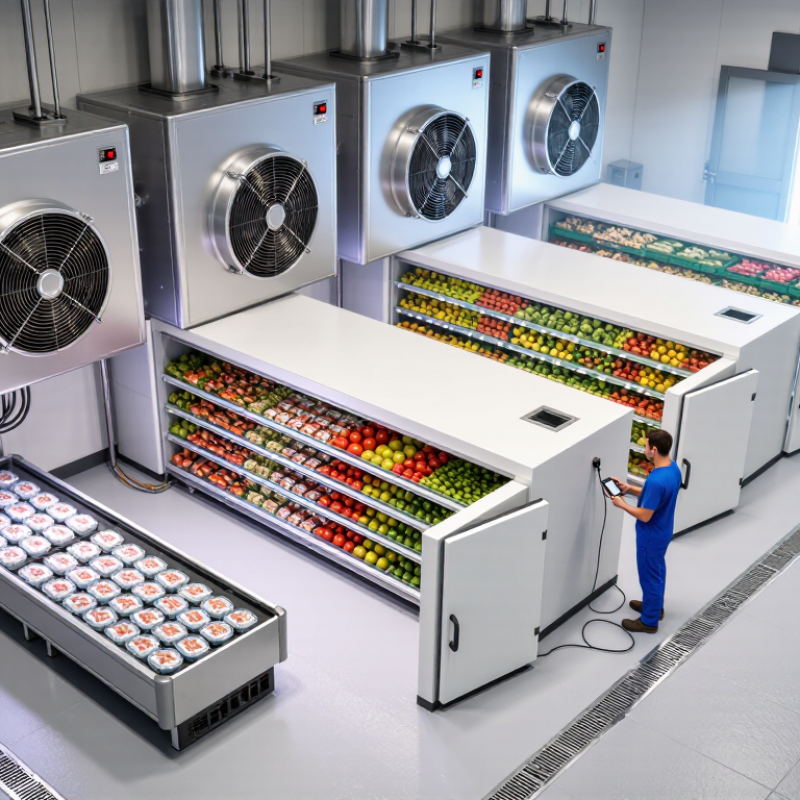
Choosing the right Cooling Evaporators in 2026 requires more than comparing catalog capacity and purchase price. A reliable selection begins with the actual cooling load, room dimensions, product temperature, humidity, and operating schedule. A freezer storing packaged seafood needs different performance from a fresh-produce room maintained near 2°C. Small details matter. Door openings, air movement, and defrost frequency can change results significantly.

Modern evaporators should support energy efficiency, stable temperature control, and practical maintenance. Look for fan motors with efficient operation, corrosion-resistant materials, accessible drain pans, and controls that match the refrigeration system. Refrigerant compatibility is also essential as equipment standards and environmental requirements continue to evolve. Manufacturer performance data should be checked at the expected evaporating temperature, ambient conditions, and airflow rate, not only under ideal laboratory conditions.

Field experience shows that oversized equipment may cycle frequently, while undersized units can run continuously and struggle during peak loads. Neither choice is automatically safer. A careful load calculation remains more dependable than guesswork. Still, calculations can miss real behavior, such as workers leaving doors open or frost building around the coil. That is where commissioning and regular inspection become valuable.

This guide explains how to compare Cooling Evaporators for efficiency, durability, food protection, and long-term operating value. It considers design, installation, controls, cleaning access, and service support. Some recommendations may need adjustment for your facility. That is worth acknowledging. Local climate, available technicians, and future expansion can change the best decision.

How to Choose Cooling Evaporators in 2026?

Understanding Cooling Evaporator Types and Their Core Functions

How to Choose Cooling Evaporators in 2026?

Understanding Cooling Evaporator Types and Their Core Functions

A cooling evaporator absorbs heat from air, liquid, or a process surface. Refrigerant enters at low pressure and removes thermal energy as it evaporates. The correct type depends on temperature, moisture, space, and maintenance access.

Direct-expansion evaporators suit compact systems and respond quickly to changing loads. Flooded evaporators keep the heat-transfer surface wetted with refrigerant. They can deliver strong efficiency, but they need careful oil and liquid management. Plate, shell-and-tube, and finned-coil designs serve different fluids and airflow patterns. Finned coils work well in cold rooms, especially when fans move air across exposed surfaces.

Selection should begin with the actual cooling load, not a catalog rating. Measure product temperature, room humidity, operating hours, and expected defrost cycles. A coil that looks oversized may reduce cycling, but it can also create poor humidity control. That detail is often missed.

Material compatibility matters. Stainless steel may suit hygienic liquid applications, while coated surfaces can help resist corrosion in damp environments. Check refrigerant compatibility, pressure ratings, drainage, and cleaning access. A blocked drain can damage performance before the evaporator shows visible wear.

Field conditions rarely match laboratory data. Dust, frost, unstable voltage, and irregular loading change results. Engineers should verify performance after installation and record suction pressure, outlet temperature, and frost patterns. No choice is perfect. A simple measurement is sometimes more reliable than a polished specification sheet.

Identifying the Required Cooling Capacity and Operating Conditions

Selecting a cooling evaporator in 2026 starts with the heat load, not the catalog image. Calculate product heat, room transmission, fan motors, lighting, infiltration, and defrost losses. Add a realistic safety margin, usually 10–15%, rather than doubling the estimate.

A neat spreadsheet can still be wrong. I have seen cold rooms underperform because door openings were counted only once per hour. Record product entry temperature, pull-down time, room volume, insulation condition, and daily door cycles. For example, a 10,000-kilogram batch entering at 5°C needs far more capacity than stored product at −18°C. Use the required cooling capacity in kilowatts, then match it with the evaporator’s rated conditions.

Operating conditions control the selection. Define refrigerant type, evaporating temperature, condensing temperature, airflow, humidity, and allowable product temperature difference. ASHRAE Handbook—Refrigeration guidance emphasizes rating equipment under stated temperature conditions, because capacity changes sharply when conditions change. A higher evaporating temperature can improve efficiency, but it may reduce dehumidification and product protection. Frost risk matters too.

Look closely at defrost frequency. Wet rooms often need wider fin spacing and stronger drainage. Dry rooms may accept compact fins. The IEA’s The Future of Cooling report projects global space-cooling electricity demand could rise from about 2,000 TWh in 2016 to 6,200 TWh by 2050. Efficiency is not optional. Still, I would recheck every assumed load on site; real operating habits rarely match the original design sheet.

How to Choose Cooling Evaporators in 2026?

Identifying the Required Cooling Capacity and Operating Conditions

The chart compares reference cooling loads for common refrigeration applications. Required evaporator capacity should be selected after calculating product load, room heat gain, fan and lighting loads, defrost effects, and a practical design margin. Evaporating temperature must also match the required product or room temperature while allowing for the evaporator temperature difference.

Reference cases use representative engineering conditions and include an approximate 20% design margin. Actual selection should be verified against refrigerant properties, airflow, humidity, defrost method, pressure drop, and the manufacturer's performance tables.

Comparing Materials, Designs, and Refrigerant Compatibility

Choosing a cooling evaporator in 2026 requires more than comparing price and surface area. Material selection affects heat transfer, corrosion risk, weight, and maintenance. The ASHRAE Handbook—Refrigeration reports thermal conductivity near 390 W/m·K for copper, 205 W/m·K for aluminum, and only about 16 W/m·K for stainless steel. Copper often transfers heat faster, while aluminum can reduce mass and material cost. Stainless steel remains useful in hygienic or corrosive environments, although its lower conductivity demands careful coil design.

Design should match the operating load, not just the cabinet size. Finned coils suit air-cooling systems, while plate or shell-and-tube evaporators can perform better in liquid applications. Wider fin spacing helps reduce frost blockage in low-temperature rooms. It also makes cleaning easier. The International Energy Agency estimates that space-cooling demand could more than triple globally by 2050, increasing pressure to improve seasonal efficiency. That projection makes oversized or poorly defrosted evaporators difficult to justify.

Refrigerant compatibility is the practical checkpoint. ASHRAE Standard 34 classifies refrigerants by toxicity and flammability, while Standard 15 addresses system safety. Material compatibility must include oils, seals, brazing metals, and pressure ratings. Lower-global-warming-potential refrigerants can operate at different pressures and temperatures, so an old evaporator may not be a safe replacement. The 2024 UNEP Emissions Gap Report reinforces the need for lower-emission cooling choices, but efficiency claims still require measured testing. Field conditions are messy. Laboratory results can mislead.

How to Choose Cooling Evaporators in 2026? - Comparing Materials, Designs, and Refrigerant Compatibility

Practical comparison of common evaporator constructions for refrigeration and cooling systems
Evaporator Type Typical Construction Materials Common Design Configuration Refrigerant Compatibility Heat-Transfer and Operating Characteristics Main Advantages Key Limitations and Selection Risks Typical Applications
Finned-Tube DX Evaporator Copper tubes with aluminum fins are common.
Aluminum tubes and fins may also be used in all-aluminum designs.
Direct-expansion circuit with multiple tubes, return bends, fins, and an air-side fan. Tube spacing can be adjusted for clean or frost-prone air. R-134a R-404A R-407C R-410A R-448A/R-449A R-454C
Also suitable for other HFC/HFO blends when the coil, oil, seals, and safety classification are approved.
Good air-side performance and flexible circuiting. Frost formation can significantly reduce airflow and capacity, so defrost strategy and fin spacing are important. Versatile, widely available, easy to configure for different air temperatures, and suitable for many air-cooling duties. Copper is generally unsuitable for ammonia service. Aluminum components require corrosion protection in aggressive or saline atmospheres. Refrigerant distribution must be designed carefully to avoid maldistribution and poor superheat control. Cold rooms, display cases, air handlers, blast chillers, process-air coolers, and comfort-cooling equipment.
All-Aluminum Microchannel Evaporator Aluminum flat multiport tubes, aluminum fins, and aluminum headers. Compact parallel-flow or multiport passages with a high external surface-area-to-volume ratio. R-134a R-410A R-32 R-454B R-454C
Also used with selected HFO/HFC blends and carbon dioxide only when specifically pressure-rated and engineered for that duty.
High compactness and low internal refrigerant volume. Performance is sensitive to refrigerant distribution, circuit arrangement, and fouling on the air side. Compact size, reduced material volume, low refrigerant charge potential, and good air-side heat transfer. More difficult to clean internally, less tolerant of mechanical damage, and vulnerable to galvanic or chemical corrosion. Standard aluminum microchannel construction is not a default choice for ammonia. Packaged air-conditioning units, heat pumps, transport cooling, and space-constrained air-cooling equipment.
Brazed Plate Heat Exchanger Stainless-steel corrugated plates joined by copper or nickel-based brazing, depending on the refrigerant and service requirements. Compact counterflow plate pack with refrigerant on one side and water, glycol, or another secondary fluid on the other side. HFC/HFO blends R-717 ammonia* R-744 CO₂* R-290 propane*
Compatibility depends on plate material, braze alloy, pressure rating, oil, and the manufacturer’s approval.
High heat-transfer coefficients and close temperature approach are possible. Pressure drop can rise quickly at high flow rates or with narrow channels. Very compact, efficient, low hold-up volume, and well suited to liquid-to-refrigerant evaporating duties. Internal fouling is difficult to remove mechanically. Freezing, rapid pressure transients, or poor water treatment can damage plates. Ammonia service requires a construction specifically approved for ammonia; copper-brazed units should not be assumed compatible. Chillers, heat pumps, secondary-loop systems, process cooling, and domestic or commercial hot-water heat pumps.
Shell-and-Tube Evaporator Carbon-steel or stainless-steel shell with copper, cupronickel, stainless-steel, or titanium tubes, selected according to fluid chemistry and pressure requirements. Flooded or DX shell-and-tube arrangement. The refrigerant may boil inside tubes or on the shell side, depending on the design. R-717 ammonia R-744 CO₂* HFC/HFO blends
Material selection is critical: copper and ammonia are generally incompatible, while stainless steel is commonly considered for ammonia circuits.
Robust construction, stable operation, and good suitability for large water or glycol flows. Flooded designs can provide high evaporating-side performance but require reliable oil management. Durable, serviceable, scalable, and suitable for industrial capacities and dirty or treated secondary fluids. Larger footprint and refrigerant charge than compact plate units. Tube fouling, corrosion, freezing, and refrigerant-side oil return must be addressed during design. Industrial chillers, large process systems, central refrigeration plants, and marine or heavy-duty cooling systems.
Flooded Evaporator Usually shell-and-tube or shell-and-coil construction using steel, stainless steel, or other verified alloys. Refrigerant level is maintained so the heat-transfer surface remains wetted; a separator or surge vessel is often included. R-717 ammonia R-134a R-513A R-1234ze(E)
Can be used with other refrigerants when the vessel, controls, oil, and materials are appropriately rated.
High evaporating-side heat-transfer performance and low superheat across much of the surface. Requires level control, oil return management, and protection against liquid carryover. Efficient at large capacities, stable outlet temperature, and good performance with relatively small temperature approaches. More components and controls than a simple DX system. Liquid carryover can damage compressors, and refrigerant charge may be comparatively high. Large chillers, industrial refrigeration, process cooling, and systems with steady thermal loads.
Immersed Coil Evaporator Stainless steel, carbon steel, titanium, or other alloy tubing immersed in a tank or vessel. Copper may be used only where fluid compatibility is confirmed. Coils are submerged in water, brine, glycol, or a process liquid; refrigerant may circulate inside the coil. R-717 ammonia* HFC/HFO blends R-744 CO₂*
The fluid being cooled and the coil metallurgy must both be checked, especially for brines, food liquids, and corrosive solutions.
Provides thermal buffering and can reduce short cycling. Heat transfer depends strongly on liquid movement, coil arrangement, fouling, and tank mixing. Simple concept, good thermal inertia, low air-side maintenance, and useful for batch or process cooling. Large tank volume, slower response than direct air cooling, potential biological or mineral fouling, and difficult access for cleaning. Ice banks, beverage cooling, process tanks, glycol systems, and agricultural or food-processing applications.
Plate-and-Frame Evaporator Stainless-steel plates with elastomeric gaskets; plate alloys and gasket materials vary with fluid and temperature. Demountable gasketed plates arranged for counterflow heat exchange between refrigerant and a secondary fluid. HFC/HFO blends R-717 ammonia*
Refrigerant use requires a design specifically rated for two-phase service, pressure, gasket compatibility, and the selected refrigerant.
High heat-transfer coefficients and adjustable surface area. Two-phase flow distribution and gasket performance require careful design. Openable for inspection and cleaning, capacity can be expanded, and close temperature approaches are achievable. Gaskets age with temperature and chemical exposure. Not all gasketed plate units are suitable for refrigerant duty, high pressure, flammable refrigerants, or vacuum conditions. Large water-to-refrigerant systems, process chillers, district cooling, and installations requiring cleanability.
Evaporative Surface or Falling-Film Evaporator Stainless steel, nickel alloys, or other corrosion-resistant materials selected for the process fluid and refrigerant. Refrigerant evaporates on or within a wetted heat-transfer surface while a liquid film flows over the surface. HFC/HFO blends R-717 ammonia R-744 CO₂*
Exact compatibility depends on pressure, metallurgy, lubrication, seals, and the specific falling-film arrangement.
Can achieve high surface utilization and low refrigerant inventory in suitable designs. Performance depends on maintaining uniform wetting and preventing dry areas. Potentially low charge, efficient heat transfer, and good suitability for large industrial duties. Sensitive to distribution, oil contamination, fouling, and operating transients. Requires sophisticated control and commissioning. Industrial chillers, large process systems, low-charge refrigeration, and applications with stable liquid circulation.

* Refrigerant compatibility is not determined by heat-exchanger geometry alone. Always verify design pressure and temperature, refrigerant safety class, material compatibility, brazing or welding method, lubricant, gasket and seal compatibility, corrosion conditions, pressure-relief requirements, and applicable local standards before selection.

Evaluating Energy Efficiency, Maintenance, and Installation Requirements

How to Choose Cooling Evaporators in 2026?

Evaluating Energy Efficiency, Maintenance, and Installation Requirements

Choosing an evaporator starts with the room, not the catalogue. Measure temperature, humidity, product load, and door-opening frequency. A freezer storing boxed food needs different airflow than a humid produce room. Poor sizing creates long compressor cycles, uneven temperatures, and unnecessary electricity use.

Look for efficient fans, variable-speed controls, and coils designed for the target temperature range. Ask for tested capacity data, not only marketing figures. In field assessments, I check the air path with a simple temperature map. It often reveals warm corners that software predictions miss. Small details matter.

Maintenance access should be visible before installation begins. Technicians need space to clean fins, inspect drains, replace motors, and test defrost controls. A narrow ceiling void can turn a minor repair into a costly shutdown. Choose corrosion-resistant materials where moisture remains high. Check drain slopes carefully. Ice tells a story.

Installation planning also includes pipe length, insulation, electrical load, and safe service clearance. Reliable suppliers should provide manuals, performance data, and realistic maintenance intervals. Local technicians should understand the equipment and the room’s operating conditions. I would not trust an evaporator selected from capacity alone. It is tempting, but incomplete. A spreadsheet helps, but it can lie. Recheck assumptions after the room is running.

Selecting the Best Evaporator for Your Application and Budget

Choosing a cooling evaporator in 2026 starts with the application, not the catalog price. A small cold room, process chiller, and transport unit require different heat-transfer priorities. Define the target temperature, refrigerant, airflow, operating hours, and available installation space. Measure the load carefully. Guesswork often creates expensive oversizing.

For a tight budget, compare total ownership cost rather than purchase price alone. Review capacity at your actual operating conditions, power demand, defrost requirements, cleaning access, and expected service life. Check published performance data and verify pressure ratings, material compatibility, and relevant safety requirements. A cheaper evaporator may need more frequent defrosting or consume more electricity. That difference becomes visible on monthly bills. It is easy to miss.

Field evaluations also show that maintenance access can matter more than a small efficiency gain. Choose coil spacing that matches the dust and moisture level in the room. Confirm that fans, drains, sensors, and replacement parts are practical for local technicians. Ask suppliers for test conditions, not just headline capacity. Data without context can mislead. A spreadsheet helps, but it cannot reveal vibration, icing patterns, or awkward access behind a panel. Leave a realistic contingency in the budget. Even experienced teams occasionally underestimate installation changes, downtime, or commissioning work. Test the selected unit under normal and peak conditions before approving full deployment.